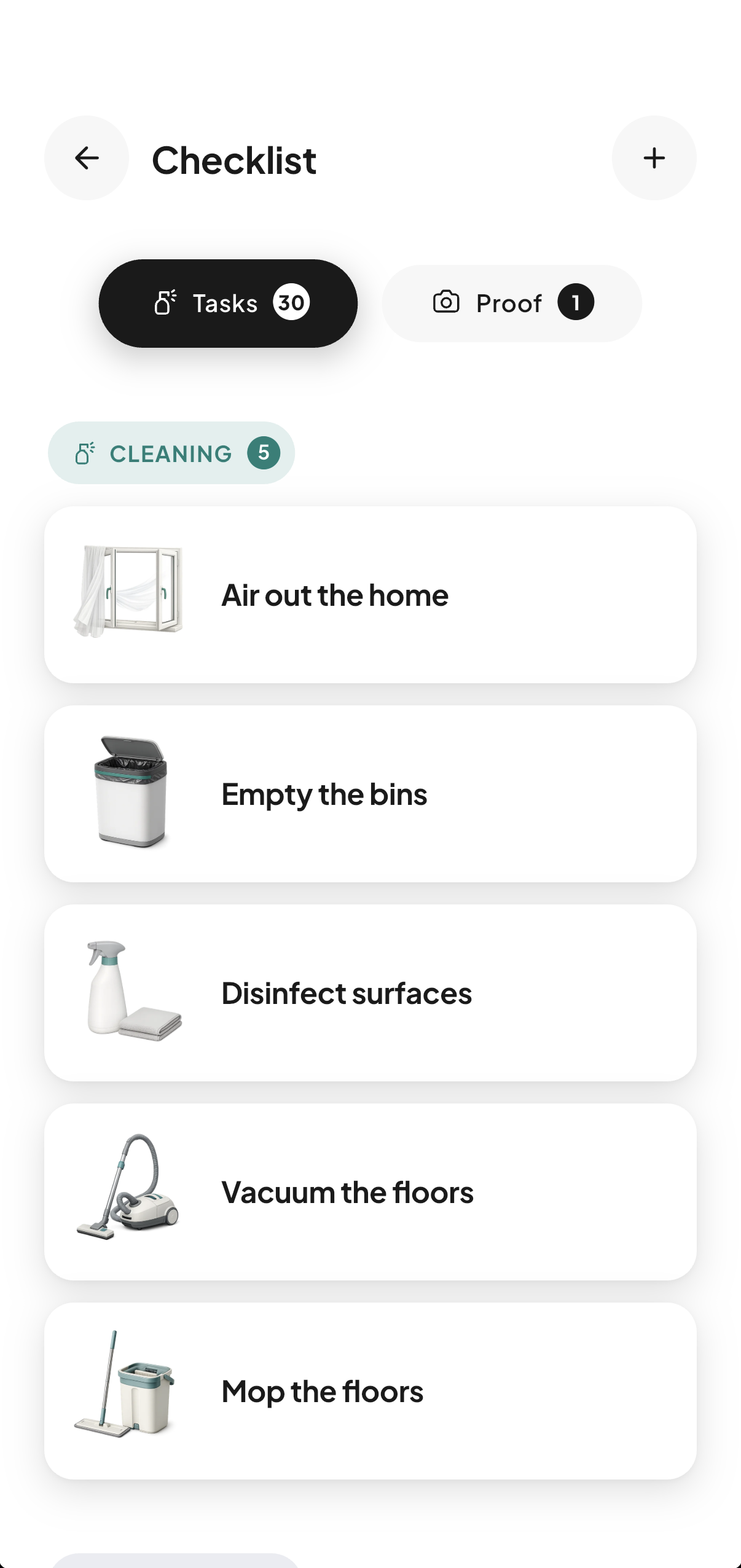

Cleaning Quality Control: Always Require Photos
Photos after every clean: checkpoints, timestamps, guest disputes. The method to validate quality remotely without travelling.
The message arrives at 16:04: "Hello, the property isn't clean, there are hairs in the shower and the bin hasn't been emptied." The guest has just arrived, you're 300 kilometres away, and your cleaner confirmed "cleaning finished" at 13:30. Who do you believe? Without proof, you have no idea, and you're the one who pays: goodwill gesture, partial refund, mediocre review visible for months.
There is a simple solution, used by all professional management companies: mandatory photos at the end of every clean. Not ten blurry snaps, but a standardised, timestamped series, covering pre-defined checkpoints. Here’s why this habit changes everything, and how to implement it without upsetting your team.
Why cleanliness leaves no room for "I think it's fine"
In short-term rentals, cleanliness is not just another criterion: it is the number one factor. Around 81% of guests cite it as the most important factor when choosing accommodation, and 78% say they're more likely to leave a positive review when the property is spotless (Hospitable / AHLA).
The reverse is also true, and measurable: a cleanliness rating that drops below 4.8 stars results in about 20% fewer bookings, and below 4.7, the loss of income can reach 30%. Lack of cleanliness is among the top three issues reported by guests, mentioned by 33% of them (ConsumerAffairs).
In other words: every missed clean is a game of Russian roulette for your rating. And unless you see the result with your own eyes, you control nothing, you just hope. Photo-based quality control turns that hope into systematic verification, after every clean.
The photo: the only proof that works remotely
A "done 👍" by text proves nothing. A video call takes time and leaves no record. The end-of-clean photo, on the other hand, has four decisive advantages:
- It can be checked in 2 minutes, from anywhere. You (or your quality manager) scan through the photo series on your phone and approve, or request a re-clean before the guest arrives.
- It’s timestamped. A photo taken at 13:27 proves the property was ready before the 15:00 check-in. It’s your trump card in case of a complaint.
- It encourages responsibility without surveillance. The cleaner knows their work will be seen: standards naturally rise.
- It documents the property’s condition. Any damage caused by previous guests appears in the photos: you can report it and claim within the deadline, as detailed in Inventory and Damages: Protecting Your Property.
This is exactly the logic behind Airbnb’s enhanced cleaning protocol, whose step 4 is "check" using room-by-room checklists (Smoobu). The photo is simply the traceable version of this check, essential as soon as you’re not cleaning yourself.
Which photos to require? The 12 to 15 checkpoints that matter
The classic pitfall: asking for "some photos" without specifying which ones. You then get three snaps of the lounge and nothing of the bathroom, the room that generates the most complaints. The golden rule: a fixed list of checkpoints, the same every time, defined by you, not left to the cleaner’s choice.
A solid base for a typical property (expect 12 to 15 photos, or 3 to 4 minutes at the end of the clean):
Bedroom(s)
- The made bed, wide shot: this is THE photo the guest will see in real life on arrival.
- Under the bed or floor/skirting board corner: where hidden dust lurks.
Bathroom
- Shower/bath empty and hair-free (close-up of the drain).
- Toilet open, seat up.
- Mirror and taps (limescale is obvious in photos).
- Towels folded and placed.
Kitchen
- Hob and sink empty and degreased.
- Inside of fridge and microwave open: the two most common oversights.
- Bin empty with new liner.
Lounge and general
- Wide shot of the lounge "photo-ready".
- Consumables restocked (toilet paper, soap, new sponge).
- Meter or thermostat if special instructions, door locked or key box closed.
Adapt this list for each property (outdoor areas, washing machine, sofa bed). The key is that it’s written down, illustrated with reference photos ("this is how the bed should look"), and part of your protocol, the full process is described in Professional Cleaning Protocol: The Guide for Your Rentals.
Implementing the process without alienating your team
Photo checks fail when seen as a sign of distrust. They succeed when presented, genuinely, as mutual protection. Three points to share with your cleaners from the start:
- "The photos protect you, first and foremost."If a guest makes a mess and complains, the timestamped photo proves the clean was impeccable. Without it, it’s your word against theirs, and the benefit of the doubt rarely goes to the cleaner.
- "No more back-and-forth."The photo replaces the need for a physical check, for you and for them.
- "The list is fixed, no surprises."Same photos, same validation criteria every time. No unexpected criticism about something never mentioned.
On the organisational side, three rules make all the difference:
- Include the 3-4 minutes for photos in the paid time for the clean. A one-bedroom flat clean takes about 60 minutes on average: allow 65, and say so explicitly.
- Approve quickly. If the cleaner sends photos at 13:30, they need to know before leaving if a re-clean is needed. Approving at 19:00 is pointless if check-in was at 15:00.
- Give positive feedback, not just corrections. A "perfect bed today 👌" now and then keeps motivation up far better than a list of complaints.
When a new cleaner starts, do the first clean together and take the reference photos as a team: after two or three cleans, the habit is set.
Guest disputes: your photos are worth gold
The scenario at the start, "the property was dirty", is resolved in three messages when you have proof:
- The guest complains.
- You reply calmly, with timestamped photos: "The clean finished at 13:27, here’s the exact state of the property. Could you show me what’s wrong?"
- Either the opportunistic complaint disappears, or the problem is real and specific, and you fix it, without refunding the whole stay.
These same photos work the other way too: if the departing guest has damaged or excessively dirtied the property, your post-clean photos from the previous stay objectively document the damage for a compensation claim. Platforms detail their claims procedures in their help sections, Airbnb Help Centre for AirCover, Booking.com Partner Hub for Booking. In both cases, dated, organised evidence makes the difference between an accepted and a rejected claim.
Two technical requirements for your photos to have real value:
- Reliable timestamping: the date and time must be indisputable (metadata or app-based timestamp), not added by hand.
- Linked to the right clean: a photo lost in a WhatsApp thread of 400 messages is impossible to find six weeks later when the platform asks for proof. Each series must be linked to a property and a specific clean date.

WhatsApp, email, app: where should photos be sent?
Many hosts start with instant messaging. It works… for two weeks. Then the problems appear:
- Photos are mixed in with other conversations, with no sorting by property or date.
- Compression reduces image quality, and there’s no guarantee of timestamping.
- Impossible to see at a glance which cleans today are approved and which are waiting for a check.
- When a cleaner leaves, the history leaves with them.
Manual filing (cloud folders by property/date) is more rigorous but time-consuming. That’s why management companies, who handle on average 30 to 50 properties, use specialist apps where the checklist and photos are built into each job: the cleaner ticks off tasks, attaches photos to the required checkpoints, and the host approves remotely. Each proof is automatically timestamped, linked to the right property, and archived. The cleaning job is created automatically for every booking, closing the quality loop. If your between-bookings organisation is still DIY, start with Organise your cleaning between bookings without stress.
The 3 mistakes that ruin photo quality control
- Too many photos.Demanding 40 photos per clean takes 15 minutes and drowns out the important points. 12 to 15 targeted photos are enough; save longer series for deep seasonal cleans.
- Checking with no follow-up.If photos are never looked at, the team will know within two weeks and standards will collapse. Approve every series, even with a simple thumbs up, and request a re-clean when needed.
- Changing the rules without warning.Adding checkpoints on the fly creates confusion and resentment. Any change to the list should be communicated, explained, and applied from a set date.
Move to systematic quality control
With Cleanclac, every Airbnb or Booking reservation automatically generates a cleaning job, and your cleaner finishes with a checklist including mandatory photos of your checkpoints: which you approve remotely, with timestamped, archived proof for each property. Discover cleanclac.com and turn every clean into a verified clean.
Your questions
How many photos should I ask for after each clean?
Between 12 and 15 photos for a standard property: made beds, shower and toilets, open fridge and microwave, empty bins, consumables restocked, overview of each room, about 3 to 4 minutes at the end of the clean. More than 20 photos every time and the process becomes a burden.
Are cleaning photos valid proof in case of a dispute?
Yes, provided they are reliably timestamped and linked to a specific clean. Platforms review the evidence provided for claims (damage, cleanliness complaints): photos dated from the end of the clean, showing the exact state of the property before the guest arrived, carry real weight compared to a simple statement.
My cleaner refuses to take photos, what should I do?
First, explain that the photos protect them too: if a guest complains, they prove the work was done. Include photo time in paid time and set a stable list of checkpoints. If they still refuse despite a fair process, it’s a serious red flag.
Should I check the photos before every check-in?
Ideally, yes: the check only has value if it allows a re-clean before the guest arrives. Simple rule: photos sent as soon as the clean is finished, approval within the hour. On a same-day turnover with check-in at 15:00, this responsiveness gives you time to fix any oversight.
Does photo control replace on-site inspections?
No, it spaces them out. Photos cover routine checks for each clean; a physical inspection (monthly or quarterly) is still useful to check what photos can’t show: smells, mattress wear, sealant condition, minor maintenance. The two work together.

Written by Janik
Published on August 7, 2026 · Updated on August 12, 2026
Read next
 Organise your cleaning between bookings without stressCheck-out/check-in window, scheduling, multi-property prioritisation, plan B: the complete method to organise your Airbnb cleaning without stress.Managing turnovers
 Remote Cleaning Management for Short-Term RentalsNon-resident host? Local team, photo checks, iCal sync, handling the unexpected: the complete method for managing your Airbnb cleaning remotely.Managing turnovers
 Same-day turnover: how to nail same-day cleaningCheck-out at 11am, check-in at 3pm: flawless same-day turnover cleaning with precise timing, ready linen kit, team organisation and handling surprises.
Move from theory to practice.
One property free to put all of this in place, for as long as it takes.