Professional Cleaning Protocol: The Guide for Your Rentals
Create a professional cleaning protocol for your short-term rental: document, train, quality control and improve, step by step.
A spotless clean when you do it yourself, average with your usual cleaner, a disaster with her stand-in: if this sounds familiar, the problem isn’t your team’s motivation. It’s the lack of a protocol. In a hotel, quality never depends on one person: it’s written down, taught, checked and constantly improved. You can apply this logic to your short-term rental, even with just one property. And it’s far from cosmetic: 81% of travellers say cleanliness is their number one factor when choosing accommodation (AHLA study cited by Hospitable), and a cleanliness rating dropping below 4.8 can cost you around 20% of bookings. Here’s the complete method to build your protocol: document, train, measure, improve.
Why a Written Protocol Changes Everything (Even for a Single Property)
As long as your cleanliness standard only exists in your head, every clean is an interpretation. A written protocol turns a vague demand (“the property must be spotless”) into a series of verifiable actions: the fridge is emptied and wiped, touch points are disinfected, the bed is made with hospital corners, all three sets of keys are in place.
The concrete benefits:
- Consistent quality, whoever does the clean, even a last-minute replacement.
- Faster training: a new cleaner becomes autonomous after a few cleans, not a few weeks.
- Fewer disputes: if a guest complains, you can prove what was done, when and by whom.
- A measurable commercial lever: listings with 5-star cleanliness ratings are booked about 25% more often (Smoobu).
A protocol isn’t paperwork for big agencies: it’s the tool that lets you delegate without losing quality, essential if you want to go from 1 to 3, then 10 properties.
Step 1, Document: Write Your Cleanliness Standard
Start by doing (or observing) a full clean yourself, stopwatch in hand, noting every action. This gives you the raw material for your protocol. Then structure it into three documents.
The Property Sheet
One page per property: address, access (codes, key box), location of equipment and products, linen stock, special features (delicate flooring, tricky appliances), emergency contacts. This is the document that makes a property operable by anyone.
The Room-by-Room Checklist
The heart of the protocol. For each room, list tasks in the order they should be done (top to bottom, back to front), distinguishing between routine and periodic tasks (descaling, under beds, extractor fan filters). Take inspiration from Airbnb’s enhanced cleaning protocol, structured in 5 steps: prepare, clean, disinfect, check, reset, rolled out in the UK from 2020 (Airbnb Newsroom). The key logic: you clean (remove dirt) before disinfecting (kill germs, with contact time), and check each room before putting out fresh linen.
The Finishing Standard
This is what separates a basic clean from a hotel-standard one: bed creases, towel folding, label direction, cushion arrangement, toilet paper folded to a point. The most effective: one reference photo per area, taken when the property is perfect. A picture is worth ten lines of instructions.
For linen, set the rule in black and white: full change after every departure and wash bedding at 60°C, a temperature that kills dust mites and bacteria (Direct Hôtellerie). Professionals use the RABC method (NF EN 14065 standard) and its “forward flow” principle: dirty and clean linen never cross paths.
Step 2, Calibrate Times and Resources
An unrealistic protocol will be ignored in the first week. Set timings that are achievable. Market benchmarks: 35 to 45 minutes for a studio, about 60 minutes for a one-bed flat, 100 to 120 minutes for a 100-125m² house. Add a buffer for tricky cases (long stays, pets, parties) and specify in the protocol what triggers a “deep clean” that can be charged extra. For more detailed estimates by property type, see our in-depth analysis: How long does Airbnb cleaning take? The real numbers.
On resources, the protocol should specify:
- The product kit: one product per use (degreaser, descaler, disinfectant, glass, floors), always stored in the same place. Check safety instructions and avoid dangerous mixtures, ANSES documents chemical risks of cleaning and biocidal products.
- Equipment: colour-coded microfibres (one colour per area to avoid cross-contamination bathrooms → kitchen), vacuum, squeegee.
- Buffer stock: consumables and spare linen on site, with a restock threshold.
Step 3, Train Your Team on the Protocol
A document nobody reads doesn’t standardise anything. Training happens in three stages:
- Demonstration cleanYou do a full clean in front of the cleaner, checklist in hand, talking through the critical points (disinfectant contact time, room order, finishing touches).
- Supervised cleanThe cleaner does the work, you observe and correct in real time. Two or three sessions are usually enough.
- Checked cleanThe cleaner works alone, you inspect afterwards (or approve remotely via photos) and debrief.
Three rules for long-term success: provide the protocol in a format viewable on a smartphone (no one carries a binder); always explain the *why* behind a rule; and make it a co-created document: a cleaner who suggested an improvement will follow it ten times better. If you manage remotely, this phase is even more crucial: Remote Cleaning Management for Short-Term Rentals.
Step 4, Measure: Systematic Quality Control
What isn’t measured slips. Quality control relies on two complementary mechanisms:
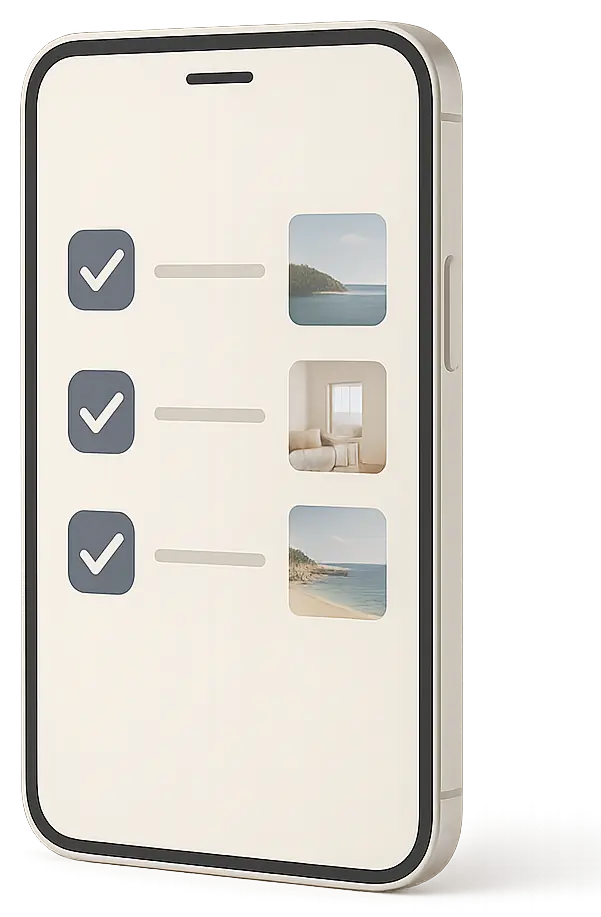
- Photo validation: at the end of each clean, the cleaner photographs the critical areas defined in the protocol (made bed, bathroom, kitchen, overview of living area). You approve remotely in two minutes, and build up a timestamped history that’s invaluable in case of a guest dispute. Full details here: Cleaning Quality Control: Always Require Photos.
- Periodic on-site inspection: one surprise visit per month per property, with a scoring grid (10 to 15 points, marked compliant / non-compliant). This picks up what photos miss: smells, high dust, under furniture.
Track three simple indicators: your cleanliness rating on each platform, the compliance rate of your inspections, and the number of cleanliness complaints per month. Remember the danger zone: below 4.8 for cleanliness, the commercial impact is swift. Travellers’ criteria are clear: in a 2026 survey of 1,758 travellers, 78% cited flawless cleanliness as the top sign of a quality listing (Vrbo / Businesswire).
Step 5, Improve: Keep the Protocol Alive
A protocol that never changes dies in six months. Set up a continuous improvement loop:
- Every guest review mentioning cleanliness (positive or negative) is analysed: which part of the protocol worked or failed?
- Every inspection non-compliance triggers action: rewording the instruction, adding a reference photo, raising the point at the next debrief.
- A quarterly protocol review with the team: what takes too long, what’s missing, what’s now pointless. Date each version (v1.0, v1.1…) so everyone works from the same reference.
Platform guidelines change too: keep an eye on Airbnb’s cleanliness standards and official expectations via their Help Centre. And if you’re aiming for an eco-friendly approach, ADEME publishes reliable guidance on green cleaning and ecolabels, an increasingly visible selling point in reviews.
The 5 Mistakes That Kill a Cleaning Protocol
- The epic protocol40 pages no one opens. Aim for one-page checklists per room, with photos.
- Standards with no time or budgetDemanding hotel finishes while paying for a 45-minute studio clean is asking for corners to be cut on invisible tasks.
- No checksA protocol that’s never checked becomes a suggestion in three weeks.
- All in someone’s headInstructions given verbally or scattered in lost message threads. The protocol must live in one tool, accessible to the whole team.
- Punitive protocolIf it’s only used to punish, the team resents it. Use it first to recognise good work, it’s also a way to keep your best cleaners loyal.
As your portfolio grows, these mistakes get more expensive: standardisation is exactly what lets you go from 2 to 10 properties without falling apart.
Standardise Your Protocol with Cleanclac
A protocol only works if it’s followed for every clean, by every cleaner. With cleanclac.com, your property checklists are right in your team’s pocket, with photo proof at every key stage and remote approval in seconds. Cleans are scheduled automatically with each booking thanks to iCal sync: the protocol runs itself, no more chasing.
Your questions
What is a cleaning protocol for short-term rentals?
It’s a reference document that describes exactly how each property should be cleaned and presented: order of tasks room by room, products and equipment to use, finishing standards (beds, folding, arrangement), disinfection points and checks to carry out. It guarantees identical quality whoever does the clean, and is used for training and control.
How long does it take to create a cleaning protocol?
Allow half a day to a full day for the first version: one full clean, timed and documented, then formatting the checklists and reference photos. Then plan two to three supervised cleans to train each cleaner. The perfect version doesn’t exist at the start: publish a simple v1 and improve it with each cycle.
Do you need a different protocol for each property?
No. Keep a core protocol (order of tasks, finishing standards, hygiene and linen rules) valid everywhere, and add a specific sheet per property: access, special features, equipment location, key points. This keeps documentation manageable while covering each property’s quirks.
How can I check the protocol is followed without being on site?
Combine two tools: end-of-clean photos of the critical areas defined in advance, approved remotely after each clean, and a monthly physical inspection with a scoring grid. Also track your cleanliness rating: it’s the final judge, the one future guests see.
What’s the official cleanliness standard on Airbnb?
Airbnb rolled out a 5-step enhanced cleaning protocol in 2020 (prepare, clean, disinfect, check, reset), developed with health experts, and these standards remain the baseline for hosts. Details and current expectations are in the Airbnb Help Centre. Your internal protocol can go further, but never fall short.

Written by Janik
Published on August 7, 2026 · Updated on August 12, 2026
Read next
 Organise your cleaning between bookings without stressCheck-out/check-in window, scheduling, multi-property prioritisation, plan B: the complete method to organise your Airbnb cleaning without stress.Managing turnovers
 Remote Cleaning Management for Short-Term RentalsNon-resident host? Local team, photo checks, iCal sync, handling the unexpected: the complete method for managing your Airbnb cleaning remotely.Managing turnovers
 Same-day turnover: how to nail same-day cleaningCheck-out at 11am, check-in at 3pm: flawless same-day turnover cleaning with precise timing, ready linen kit, team organisation and handling surprises.
Move from theory to practice.
One property free to put all of this in place, for as long as it takes.