
Organise your cleaning between bookings without stress
Check-out/check-in window, scheduling, multi-property prioritisation, plan B: the complete method to organise your Airbnb cleaning without stress.
It’s 10:47am. Your guests have just left, 47 minutes late, the next ones arrive at 4pm, your cleaner isn’t answering, and you’ve just had a last-minute booking on your second property. Every host has been there. The good news: the stress of cleaning between bookings isn’t inevitable, it’s an organisation problem. Here’s the method: understand your turnover window, estimate the real durations, build a reliable schedule, prioritise on busy days, and have backup solutions ready before you need them.
Understand your check-out / check-in window: the key to everything
It all starts with a simple calculation: turnover window = latest check-out time − next check-in time. With a departure at 11am and an arrival at 4pm, you have 5 hours. Sounds comfortable… until you factor in the cleaner’s travel, laundry, unexpected issues, and the essential safety margin before arrival.
Three levers can widen this window without losing bookings:
- Set realistic times in your listings. A check-out at 10am and check-in at 4pm gives you a 6-hour gap. You can always make exceptions, but the reverse is much harder.
- Automate the check-out reminder. A message the night before drastically reduces late departures. How to set up scheduled messages is detailed in the Airbnb Help Centre.
- Enable self check-in where possible. Around 67% of guests prefer self check-in (Touch Stay, 2024): a key box or smart lock separates arrival from your physical presence and removes the pressure of “I must be there at 4pm sharp”.

Estimate the real time for each clean (and stop kidding yourself)
Most failed turnovers come from constantly underestimating cleaning time. The professional benchmarks in France are: allow 35 to 45 minutes for a studio, about 60 minutes for a one-bedroom, and 100 to 120 minutes for a house of 100-125m².
These times are for a standard clean, in a property left in decent condition. Always add:
- +20 to 30 minutes if you handle laundry on site (drop-off, making beds, folding);
- +30 minutes to 1 hour after a long stay, a stay with pets, or if the property is left very dirty;
- the cleaner’s travel time, often forgotten in multi-property schedules.
The right habit: actually time 4 or 5 cleans per property, then use the longest duration as your reference, a schedule based on the best case falls apart at the first hiccup.
Build a cleaning schedule that updates itself
Paper schedules or spreadsheets work… until the first cancellation or last-minute booking. Every change then has to be updated manually, and that’s where things get missed, the dreaded “property not ready when guests arrive”.
The robust solution relies on three principles:
- One single source of truth.Your Airbnb, Booking.com and other calendars export in iCal format. Synced into a central tool, every booking, change or cancellation is visible in one place. The Booking.com Partner Hub explains how to export from Booking.
- A clean automatically created for every bookingScheduled between check-out and the next check-in, with no manual entry.
- An automatic notification to your cleanerWith date, time slot, property and instructions, no more screenshotting and texting the night before.
With this chain, a cancellation removes the now-unnecessary clean and a new booking adds one: your schedule stays accurate without you lifting a finger.

Prioritise when several properties turn over on the same day
From 2 or 3 properties upwards, summer Saturdays become a headache: several check-outs in the morning, several arrivals in the afternoon, a limited team. Prioritisation then follows simple rules:
- Priority 1: same-day turnovers. Any property with a check-out AND check-in on the same day goes to the top of the list, slot blocked first.
- Priority 2: earliest arrivals. Between two turnovers on the day, start with the one whose check-in is earliest.
- Priority 3: empty properties with arrivals the next day. These are your flexible slots, to be done at the end of the round or postponed to the next morning.
- Optimise travel. Group properties by area: on a day with 4 or 5 cleans, this often saves an hour.
It matters: cleanliness is the number one factor for 81% of guests (AHLA study cited by Hospitable), and a cleanliness rating below 4.8 stars costs about 20% of bookings. A rushed clean due to poor sequencing shows up directly in your reviews. For scaling from 2 to 20 properties, see Cleaning for Multiple Properties: How to Scale Up.
Secure tight turnovers: the same-day turnover case
Cleaning on the same day between two guests is the most profitable (no lost nights) and the riskiest. To pull it off without stress:
- Prepare a full kit the day before: clean laundry sorted by room, consumables, products, everything ready to go, nothing to hunt for.
- Separate laundry from cleaning. Starting a wash during turnover is the classic trap: a cotton cycle takes 1.5 to 3 hours (Rester Connecté), not compatible with a 5-hour window. Work with two or three sets of linen per bed and wash them later.
- Lock in your cleaner’s slot in advance, with confirmation the day before.
- Keep a 45-minute buffer before check-in: your cushion for the unexpected.
For a minute-by-minute protocol, see Same-day turnover: how to nail same-day cleaning.
Have a plan B before you need it
The stress doesn’t come from the unexpected itself, but from not having a prepared response. Build your backup plan in advance, not in the middle of a crisis:
- A backup cleaner identified and tested. A second person (trusted neighbour, student, local company) who already knows the property and is happy to do occasional jobs, tested once in real conditions.
- A 30-40 minute express checklist: the “bare minimum” version of your clean (beds, bathroom, visible floors, bins, touch points) for when you have to step in yourself.
- Instructions accessible without you. Access codes, location of products and linen, quirks: everything must be available to a stand-in who’s never been before.
- A clear early check-in policy: only accept once cleaning is confirmed finished, never before.
Crisis scenarios (cleaner absent on the morning, surprise same-day booking) deserve a detailed plan: we cover them in Last-minute cleaning: managing absent cleaners and surprises.
Check without being there: the trust loop
The final pillar of stress-free organisation: knowing the clean is done, and done well, without having to go in person. The professional property manager’s method has three points:
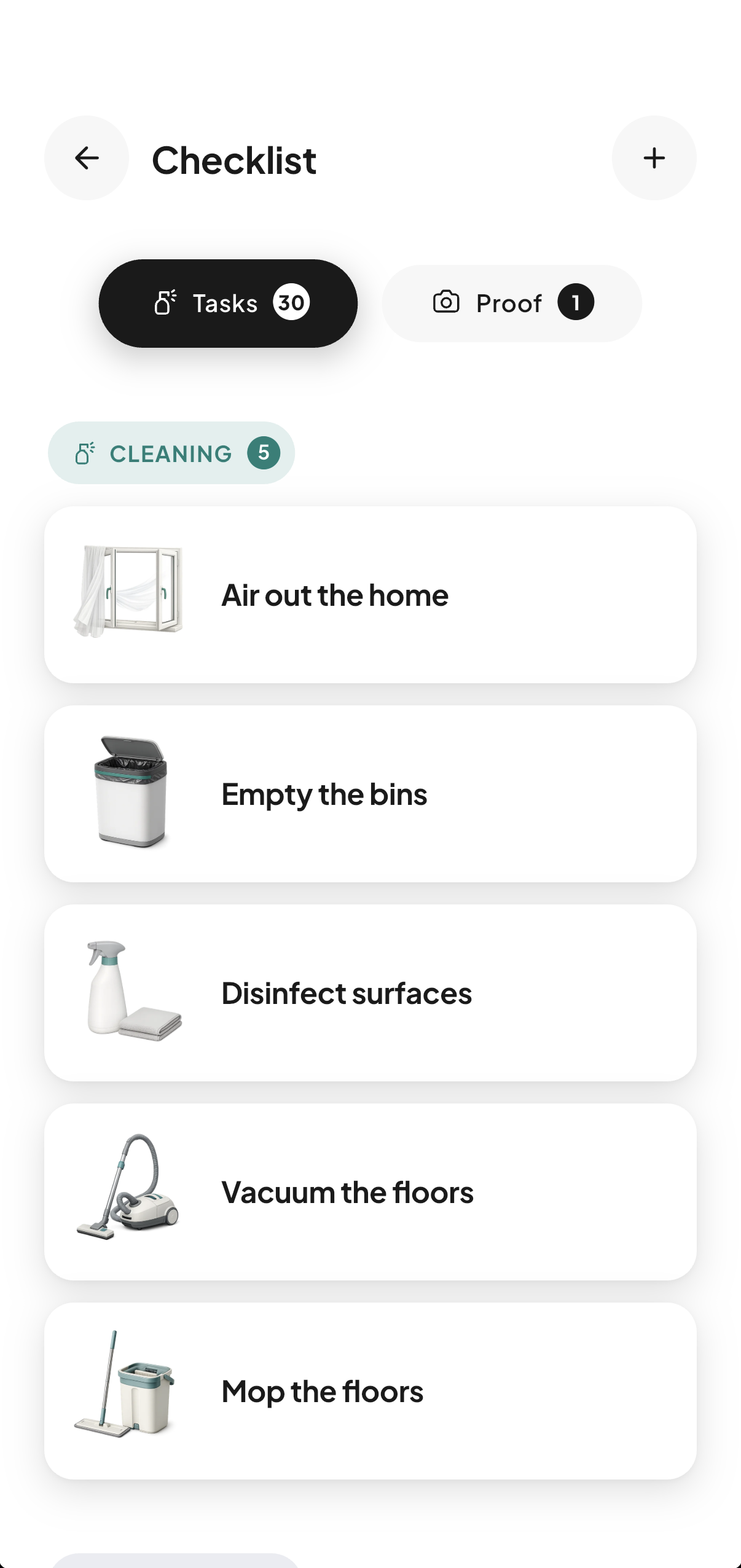
- A checklist for each property, room by room, ticked off by the cleaner as they go, memory is never enough, especially for a stand-in.
- End-of-job photos of key areas: made bed, bathroom, kitchen, overview. Both quality control and timestamped proof in case of a guest dispute.
- A completion notification: you know in real time that the property is ready and can send arrival instructions with peace of mind.
This loop changes everything: you no longer wonder “is it done?”, you see it. And it’s worth it: listings with 5-star cleanliness are booked about 25% more often (Smoobu).
In summary: organisation replaces stress
A realistic turnover window, honest time estimates, a self-updating schedule, clear priorities on busy days and a plan B ready before crisis: these are the five pillars of stress-free cleaning organisation. Combine them and your turnovers become a smooth routine.
That’s exactly what cleanclac.com does: iCal sync with Airbnb and Booking automatically schedules a clean for every booking, your cleaner is notified with property instructions, and photo checklists confirm remotely that everything’s ready. Try it for your next turnover schedule.
Your questions
How much time should you allow between check-out and check-in?
Allow at least 4 to 5 hours: a standard clean takes 35-45 minutes (studio) to 2 hours (house), plus the cleaner’s travel, laundry, unexpected issues and a 30 to 45 minute buffer. Check-out at 10-11am and check-in at 3-4pm is the most common standard.
How do you handle a late guest departure that throws off the whole schedule?
Send a reminder the night before with the check-out time and departure instructions. On the day, if the delay is over 30 minutes, contact the guests and immediately inform your cleaner to reschedule their round. As a precaution, state in your house rules that unauthorised late check-outs may be charged.
Should you clean immediately after every departure?
Ideally yes, even if there’s no arrival that day: you spot any damage or forgotten items straight away (within the platforms’ claim deadlines), the property is ready for a last-minute booking, and stains don’t have time to set. If not, do a quick inspection on the day of departure.
How do I sync my Airbnb calendar with my cleaning schedule?
Each platform provides an iCal export link for its calendar. By connecting this link to a cleaning management tool, every new booking automatically creates a cleaning slot between the departure and next arrival, and every cancellation removes it. No more double entry, so no more risk of forgetting. The full setup, its real refresh times per platform and its troubleshooting are detailed in iCal Sync: Airbnb, Booking.com and Your Cleaning.
What if my cleaner cancels at the last minute?
Activate your plan B in order: backup cleaner already identified, then a local cleaning company that takes emergencies, then yourself with an express checklist. If nothing is sorted before check-in, inform guests early and offer a slight delay to arrival with a goodwill gesture, rather than letting them find an unprepared property.
How much does a clean between bookings cost?
In France, expect on average €22 to €35 for a studio outside Paris and €50 to €90 for a large property, more in Paris and ski resorts (15 to 30% surcharge). This cost is usually passed on via the cleaning fee charged to guests.

Written by Janik
Published on August 7, 2026 · Updated on August 23, 2026
Read next
 Remote Cleaning Management for Short-Term RentalsNon-resident host? Local team, photo checks, iCal sync, handling the unexpected: the complete method for managing your Airbnb cleaning remotely.Managing turnovers
 Same-day turnover: how to nail same-day cleaningCheck-out at 11am, check-in at 3pm: flawless same-day turnover cleaning with precise timing, ready linen kit, team organisation and handling surprises.Managing turnovers
 How long does Airbnb cleaning take? The real numbersStudio, one-bed or house: the real durations for Airbnb cleaning, the factors that affect them, and how to estimate and plan your changeovers.
Move from theory to practice.
One property free to put all of this in place, for as long as it takes.