
Cleaning for Multiple Properties: How to Scale Up
Manage cleaning for 2 to 20 short-term rentals with rounds, team, centralised schedule and checklists. The complete method for Airbnb and Booking hosts.
With a single property, a notebook and a few texts are enough. With three, Saturdays become a sport. From five onwards, one forgotten detail, a calendar not checked, a cleaner not informed, and a guest arrives to a dirty flat. The problem is not your diligence: the coordination workload does not grow in proportion to the number of properties, it explodes. This guide details the method used by professional management companies, whose typical portfolio is between 30 and 50 properties, to go from 2 to 20 properties without sacrificing cleanliness or your weekends.
Why “DIY” management breaks down after 3 properties
A figure to set the scene: the average occupancy rate in France is about 63%, rising to 71% in Paris according to key figures compiled by PriceLabs. In practice, 5 well-booked properties easily generate 15 to 25 cleans per month, often concentrated in the same time slots (Saturday between 11am and 4pm).
Three mechanisms derail manual management:
- Multiplying calendars: every property listed on Airbnb and Booking means two calendars to monitor. With 5 properties, you’re checking 10 sources of information several times a day.
- Concentrated time slots: cleaning a one-bedroom flat takes about 60 minutes, a house of 100-125m² between 100 and 120 minutes, not counting travel. Two houses to prepare on the same Saturday is already half a day for one person.
- Relying on memory alone: instructions (“the dishwasher at 12 X Street jams”, “key in box no.2”) live in your head or in lost message threads.
The classic symptom: you spend more time coordinating cleans than doing them. That’s the signal to change your system, not to work harder.

Step 1, Centralise all calendars into a single schedule
The first building block for scaling is to never check platforms one by one again. Each Airbnb or Booking listing provides an iCal link: by connecting these feeds to a central calendar, every booking, change or cancellation appears automatically in one place. The full setup, its real refresh times per platform and its troubleshooting are detailed in iCal Sync: Airbnb, Booking.com and Your Cleaning.
This single schedule should answer three questions at a glance:
- Which properties are checking outToday and tomorrow?
- Which properties are receiving guests(check-in), and at what time?
- What is the cleaning windowAvailable between the two?
Pay special attention to same-day turnovers (departure in the morning, arrival in the afternoon): these require tight planning and a confirmed cleaner in advance. The topic deserves a whole article: Same-day turnover: how to nail same-day cleaning.
A word of caution: native iCal sync between platforms can have a delay of several hours. With multiple cross-listed properties, use a tool that refreshes feeds frequently and alerts you to every new booking, rather than a manually updated calendar.
Step 2, Organise smart, geographical cleaning rounds
From 4-5 properties, travel time becomes a major hidden cost. A cleaner crossing the city between each job loses 30 to 45 minutes per turnover, time you pay for with no cleaning done.
Principles for an efficient round:
- Group by area: assign each cleaner to a coherent geographical sector (a neighbourhood, a town). Aim for less than 15 minutes between two consecutive properties.
- Sequence in the right order: start with properties with early check-ins or requests for early arrival, finish with those left empty that night. Properties with no same-day arrival are your flexible buffer.
- Spread the workload over the week: if you control your listing settings, adjust allowed arrival days or minimum stay to avoid 80% of turnovers falling on Saturday. Calendar settings are managed directly in your listing via the Airbnb Help Centre or the Partner Hub Booking.com.
- Allow for buffer time: a fully booked round falls apart at the first hiccup (guest leaves late, cleaning takes longer than expected). Keep 30 to 45 minutes spare per half-day and per cleaner.

Step 3, Structure your team: who does what at each stage
The right team size depends on the number of weekly turnovers, not the number of properties. Concrete benchmarks:
| Portfolio | Typical organisation |
|---|---|
| 2-3 properties | 1 regular cleaner + you as back-up |
| 4-8 properties | 2 cleaners (including 1 cross back-up), defined zones |
| 9-15 properties | 3-4 cleaners + 1 quality supervisor (you or a senior) |
| 16-20 properties | Structured team, pairs per zone, identified substitutes |
Three rules that prevent 90% of crises:
- Never a single point of failure: every property must be known by at least two people. One cleaner off sick on a peak Saturday must not be able to halt your business.
- One person responsible per property, not per task: the person who cleans also reports damage, low stock and forgotten items. They are your eyes on site, essential if you manage remotely, as detailed in Remote Cleaning Management for Short-Term Rentals.
- Pay fairly and give visibility: expect to pay £12 to £22/hour outside London and £20 to £35/hour in London for a cleaning contractor. A schedule given in advance and regular jobs retain cleaners far better than squeezing rates: losing a trained cleaner always costs more than £2 extra per hour.
Step 4, Standardise: a single protocol, checklists per property
What works in your head for one property must become a document anyone can follow for ten. Standardisation has three layers:
- A common protocolOrder of rooms, products used, hygiene rules (linen washed at 60°C, disinfecting touch points), bed presentation. It applies everywhere, identically.
- A sheet per propertyAccess (codes, key box), technical quirks, stock locations, number of linen sets, known pitfalls. This lets you send a substitute at short notice.
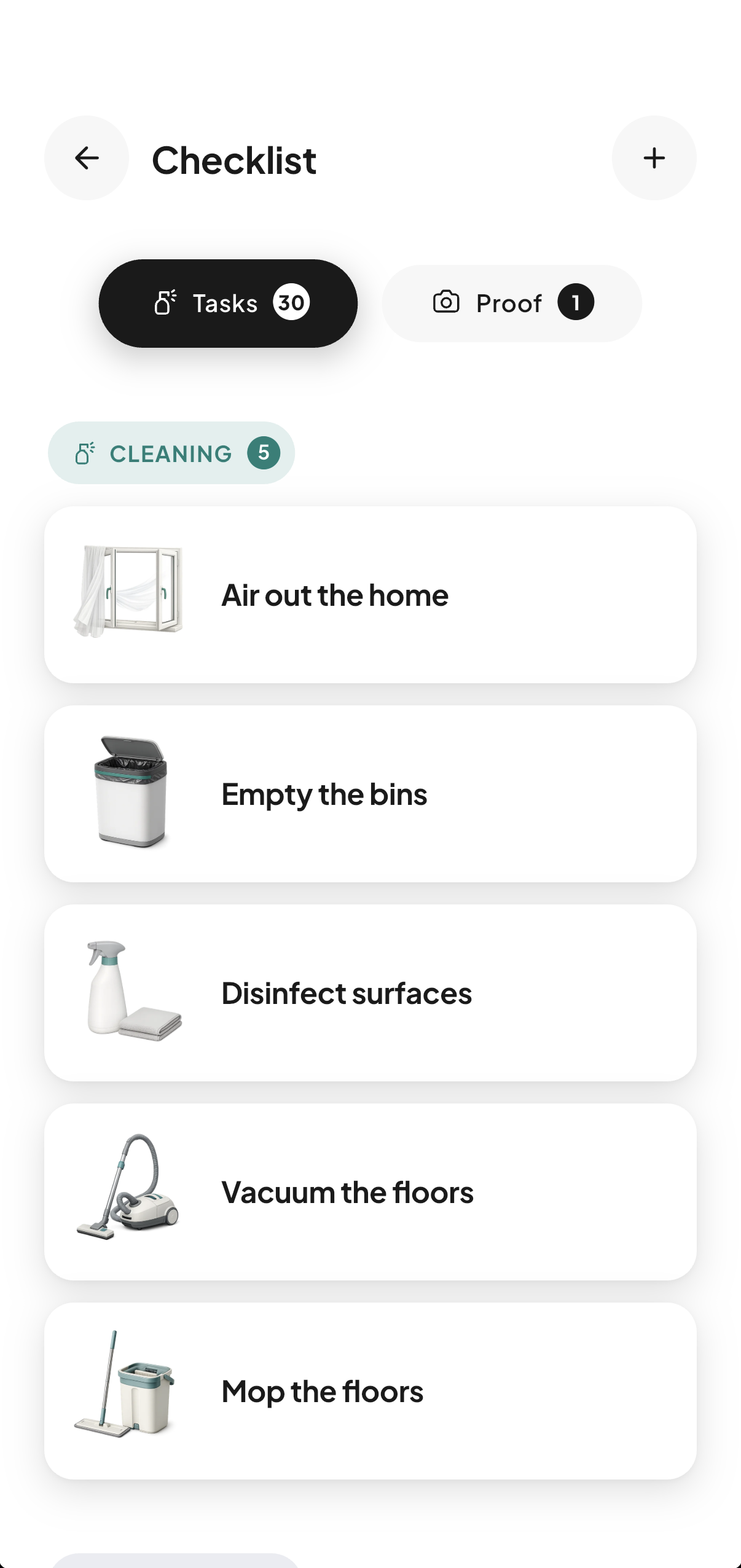
- An end-of-job checklist with photosThe cleaner ticks off each area and photographs the result (made bed, bathroom, kitchen). You check quality remotely in 2 minutes per property, no need to visit.
This is far from cosmetic: 81% of guests rate cleanliness as their number one criterion when choosing accommodation according to the AHLA study relayed by Hospitable, and a cleanliness score slipping below 4.8 can cost about 20% of bookings. Scaling up without standardising is multiplying the risk of bad reviews. Photo-based checks are covered in detail here: Cleaning Quality Control: Always Require Photos.
Step 5, Streamline linen and consumables
Linen is the first bottleneck for multi-property portfolios. Two key decisions:
- The 3-sets-per-bed rule: one set on the bed, one in the wash, one clean in reserve. Any less, and every tight turnover becomes a race against the washing machine, a useful reminder: a full cotton cycle lasts 1.5 to 3 hours, impossible for a same-day turnover if linen isn’t prepped in advance.
- One storage point per zone: from 6-8 properties, a storage space (cellar, dedicated cupboard, locker) per area avoids endless trips. The cleaner leaves with a full kit: linen, consumables, products.
For consumables (toilet paper, soap, sponges, coffee), set a restock threshold per property and have it checked on every end-of-clean checklist: shortages should be spotted during cleaning, never after a guest complaint.
The 5 most expensive growth mistakes
- Adding a property without updating your system. Every new property must be added to the standard (property sheet, checklist, cleaning round) *before* its first booking, not after the first mishap.
- Keeping all information to yourself. If everything goes through your phone, you’re the bottleneck. Document, share, use tools.
- Hiring in a rush. The right time to find a second cleaner is when the first is at 70% capacity, not when they cancel on a Saturday.
- Ignoring sync delays. A last-minute booking that doesn’t appear in your schedule means a guest at an unprepared property. Automate the chain: booking → cleaning scheduled → cleaner notified.
- Confusing growth with profitability. Track your cleaning cost per turnover (service + linen + consumables + travel): between £22 and £45 for a studio or one-bed outside London, it must stay in line with your charged fees. If it creeps up as you grow, your rounds need redesigning.
In summary: a system, not more effort
Going from 2 to 20 properties doesn’t mean working ten times harder, but replacing your memory with a system: centralised calendars, area-based rounds, a redundant team, photo checklists and pre-emptive stock management. Each building block makes the next property easier to absorb than the last.
That’s exactly what cleanclac.com does: iCal sync connects all your Airbnb and Booking calendars, every booking automatically schedules a clean, and your cleaners receive their jobs with checklists and photo validation. You manage your whole portfolio from a single screen, even remotely.
Your questions
How many properties can you manage alone without a dedicated tool?
In practice, 2 to 3 properties can be managed with a diary and manual messages, provided occupancy is moderate. Beyond that, the number of calendars to monitor and simultaneous weekend turnovers make mistakes almost inevitable. Most hosts switch to a centralised schedule between their 3rd and 5th property.
How many cleaners do you need for 10 properties?
Count the number of weekly turnovers rather than properties: 10 properties at 60-65% occupancy generate about 30 to 40 cleans per month. This usually means 2 to 3 regular cleaners organised by area, plus a trained back-up who can step in for absences or busy Saturdays.
How do you avoid missed cleans when you have several calendars?
By eliminating all manual re-entry: connect the iCal feeds from each listing (Airbnb, Booking) to a central schedule that automatically creates a clean for each new booking and notifies the assigned cleaner. Missed cleans almost always come from a last-minute booking or a change not updated, automation closes this gap.
Should you give all your properties to the same cleaner?
No, that’s a single point of failure: one absence and your whole operation stops. Best practice is to assign a main cleaner per area for consistency and local knowledge, while always training a second person on each property using detailed sheets and checklists.
What is the cleaning cost for a multi-property portfolio?
Services range from about £22-35 for a studio outside London to £70-110 for a large property in London, plus linen and consumables. With multiple properties, optimised rounds reduce travel costs and often allow you to negotiate a volume rate: track the full cost per turnover, it’s your key metric.

Written by Janik
Published on August 7, 2026 · Updated on August 23, 2026
Read next
 Organise your cleaning between bookings without stressCheck-out/check-in window, scheduling, multi-property prioritisation, plan B: the complete method to organise your Airbnb cleaning without stress.Managing turnovers
 Remote Cleaning Management for Short-Term RentalsNon-resident host? Local team, photo checks, iCal sync, handling the unexpected: the complete method for managing your Airbnb cleaning remotely.Managing turnovers
 Same-day turnover: how to nail same-day cleaningCheck-out at 11am, check-in at 3pm: flawless same-day turnover cleaning with precise timing, ready linen kit, team organisation and handling surprises.
Move from theory to practice.
One property free to put all of this in place, for as long as it takes.