Breakfast and Welcome Drinks: What’s Worth Providing
Water, coffee, tea, sugar, milk, orange or apple juice, jams: what to offer guests safely, in what quantity, and how to keep track of expiry dates.
7 min read
The welcome breakfast is the gesture that leaves the best impression for the lowest cost, but it also raises the most practical questions: what can you safely leave, what happens to unused products, and who checks the expiry dates? This guide covers drinks and breakfast from an operational perspective, not a decorative one: what is restocked at each clean, what needs checking, and what it really costs.
What to provide, and how often
| Product | Frequency | Reference quantity |
|---|---|---|
| Bottled water | At every clean | 1 per guest |
| Sparkling water | At every clean | 1 bottle |
| Coffee (pods or ground) | At every clean | 2 pods per person per night |
| Coffee beans | At every clean | Bean hopper topped up |
| Tea bags | At every clean | 4 to 6, assorted |
| Sugar sachets | At every clean | Individual sachets |
| Granulated sugar | At every clean | Sugar bowl filled |
| Milk | At every clean | 1 small UHT carton |
| Orange juice or apple juice | At every clean | 1 small bottle |
| Jams | At every clean | 2 to 3 individual portions |
Each of these lines is a restocking task in the CleanClac library, from coffee pods to apple juice, added to the catalogue in October 2026. Only choose what matches your property’s range: a transit studio may be fine with just water, coffee, and tea.
The hygiene rule that governs everything
A simple rule answers almost all questions: only leave products with a long shelf life, sealed in their original packaging, and storable at room temperature or in UHT cartons.
What meets this rule: water, UHT milk cartons, juice in small bottles, individual portions of jam and honey, tea bags, sugar sachets, coffee pods, wrapped biscuits.
What does not, and should never be part of a standard welcome: opened fresh products, opened milk bottles, butter, cheese, cured meats, homemade pressed juice, prepared dishes. A rental is not a catering service, and you would be fully liable if there were a problem.
Individual portions are not unnecessary over-packaging here: they are what allow you to leave a product for a stranger and confidently reuse unopened portions for the next guest.
Expiry dates, and who checks them
This is the point most hosts manage poorly, because products turn over slowly when not consumed.
Three habits are enough:
- Check the expiry date every time you restock, not just once a month. It takes a second and should be part of the task itself.
- Rotate your stock so the oldest is at the front, just like in a shop.
- Remove any product with less than two months left before expiry. It may not be used before then, and a guest who finds a product two days out of date will draw conclusions about the whole property.
Unopened, in-date individual portions can be left from one stay to the next. Anything opened must go, without exception, as is the logic for the fridge in Fridge, Dishwasher, Sink: Odour Prevention and Maintenance.
Water: the most universal gesture
A chilled bottle of water per guest, placed visibly on arrival, is probably the best cost-to-impact ratio in the whole rental: just a few pence, and it’s exactly what you want after a journey.
Two simple upgrades:
- A filter jug or returnable glass bottles, which replace plastic and add value to your property. In hard water areas, the jug also protects your appliances.
- A bottle of sparkling water, which costs no more and stands out because it’s rare.
In summer, leave them chilled rather than on the worktop: the gesture is the same, but the effect is very different.
If you provide a reusable bottle or jug instead of new bottles, treat it at every clean like a glass: rinse, then fill with fresh water, and chill. This is the “Fill water bottle” task, not to be confused with “Restock bottled water”, which refers to bought bottles.
Orange juice or apple juice
Juice is the breakfast drink you choose according to your guests. Orange juice remains the standard for adult or international guests; apple juice, milder and less acidic, is often preferred by families with children. There’s nothing to stop you offering both in a family rental, in small sealed bottles, chilled.
The rules don’t change: bottles sealed in their original packaging, date checked at every restock, and any opened bottle removed at departure, even if half full.
Quantities that match the stay
“Two pods per person per night” is easy to calculate for one stay, much less so for thirty properties and as many cleaners. The temptation is to provide for maximum capacity, which means buying coffee and milk for six when the property hosts a couple two nights out of three.
With CleanClac’s stock management, each product can be set to a fixed quantity or a quantity calculated according to the number of guests for the incoming stay: the cleaner reads the number to provide without counting, each clean records what was left, and a warning threshold alerts you before the cupboard is empty.
 Tea bags10
 Coffee capsules1413
 Jams8
 Bar soaps54
 Dental kit43
 Sponges76
 Toilet paper4321−1−1−1+3

Never out of supplies
Every cleaning counts down what was restocked, and quantities follow the number of guests. You are warned before you run out, not after.
More detailsThe real cost, in figures
Think per stay, not per month, and it’s more modest than you might expect.
- The basics (water, coffee, tea, sugar) cost a few pounds per stay and should be considered consumables, just like toilet paper.
- A full breakfast (juice, milk, jams, biscuits) adds a few pounds more.
- A local gourmet hamper is a separate budget, reserved for longer stays, special occasions, or high-end lets.
Per night, the basics are a negligible fraction of the price, yet almost always mentioned in reviews. The real cost is not the purchase, but the time spent restocking and checking dates, which should be built into the clean, not improvised.
The note that goes with it
A product left without explanation is ambiguous: the guest doesn’t know if it’s for them or left by the previous guest. A small card is enough, with two pieces of information: it’s complimentary, and it’s for this stay. Without it, some guests won’t touch it, and the gesture is wasted.
Prepared breakfast, for stays that deserve it
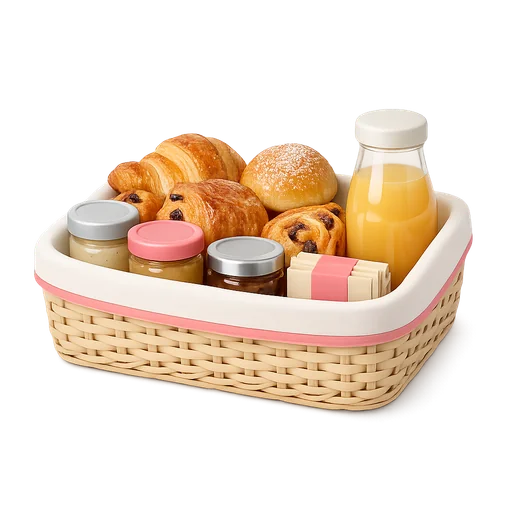
Beyond restocking, the library offers a more complete gesture: “Prepare breakfast”. This is no longer just a stocked cupboard, but a ready tray, placed in plain sight for the first morning: drinks, jams, wrapped biscuits, perhaps a jar of local honey.
It makes sense in three cases: high-end properties, late arrivals where the guest won’t find anything open, and special occasions flagged at booking. Otherwise, it takes up cleaner time for an effect the basics already achieve. As always, nothing fresh: the hygiene rule does not change just because the tray looks nice.
Other gestures, from welcome gifts to fresh flowers, are covered in Airbnb Welcome Basket: What to Offer, Budget and Why. The basic pantry items, salt, pepper, and olive oil, are in the kitchen consumables list, and coffee machine maintenance is in the descaling guide.
Your questions
What products can you safely leave for guests?
Only products sealed in their original packaging, with a long shelf life, and storable at room temperature or in UHT cartons: water, UHT milk, juice, individual jam portions, tea bags, sugar, coffee pods, wrapped biscuits. Nothing fresh, nothing opened, nothing homemade.
Should you leave a bottle of water on arrival?
It’s the best cost-to-impact ratio in the whole rental: one bottle per guest, placed clearly and chilled in summer. Just a few pence for the most universally appreciated gesture, especially after a long journey.
How do you manage expiry dates for welcome products?
Check them every time you restock, not just once a month, and remove anything with less than two months left. Rotate your stock so the oldest is at the front. A guest finding an out-of-date product says more about your property than ten things done right.
Can you leave unused products for the next guest?
Yes, for unopened, in-date individual portions. No, for anything opened, without exception, including a resealed packet of biscuits or a half-full bottle of juice. The rule is the same as for fridge contents.
How much does a welcome breakfast cost per stay?
The basics (water, coffee, tea, sugar) cost a few pounds per stay, a full breakfast a few pounds more. Per night, it’s marginal. The real cost is the time spent restocking and checking dates, which should be built into the clean, not improvised.
Should you explain that the products are complimentary?
Yes, a small card is enough. Without a note, some guests won’t touch them, unsure if they’re a gift or left by the previous guest. Two pieces of information are enough: it’s complimentary, and it’s for this stay.

Written by Janik Thoisy
Janik Thoisy manages short-term rentals day to day and shares her cleaning and organisation methods here.
Published on August 13, 2026 · Updated on November 8, 2026
Read next
 Airbnb Guest Touches: 25 Ideas That Transform a Stay25 guest touches for your Airbnb guests, sorted by budget (£0, under £5, under £20), and the method to offer them at every stay.Guest experience
 Self Check-in: Key Safe or Smart Lock?Self check-in for short-term rentals: key safe or smart lock, costs, security, mistakes to avoid, and coordination with cleaning teams.Guest experience
 Welcoming Families in Rentals: Equipment and Safety TipsWelcoming families with children in short-term rentals: baby equipment, safety, toys, enhanced cleaning, and family-friendly listings for 5-star reviews.
One property free to put all of this in place, for as long as it takes.