Eco-friendly cleaning in short-term rentals: a guide
Natural products, reliable labels, real savings and a marketing edge: the guide to eco-friendly cleaning for your Airbnb or Booking rental.
Between guests, you power through cleans with a line-up of sprays, bleach and multi-surface products. The result: a chemical smell at check-in, a swelling product budget, and guests who are increasingly attentive to environmental commitments. The good news: eco-friendly cleaning in short-term rentals takes no more time or money, often less. This guide covers natural products that really work, trustworthy labels, measurable savings, and how to make it a marketing asset.
Why switch to eco-friendly cleaning as a host
Beyond doing your bit for the planet, three very concrete reasons matter for an Airbnb or Booking host.
Health, yours and your guests'. A well-booked property can see over 150 cleans a year: repeated exposure to harsh products (bleach, ammonia, synthetic fragrances) mainly affects the person doing the cleaning. The ANSES reminds us that cleaning products and biocides carry real chemical risks, especially when mixed, bleach plus acidic descaler releases a toxic gas. Fewer products means less risk.
Your wallet. A professional benchmark puts the annual cleaning product budget at around €1,000 to €1,200 for an 80m² property cleaned regularly, excluding consumables (L'Hôtellerie Restauration). An eco-friendly multi-purpose kit costs a fraction of this, as we’ll see below.
Guest experience.78% of guests cite spotless cleanliness as the number one sign of a quality listing, and 86% say they’re willing to pay more for a higher-quality property (Vrbo 2026 study). A property that smells clean, not chemical, ticks this box from the moment they walk in.
The 6 natural products that replace (almost) everything
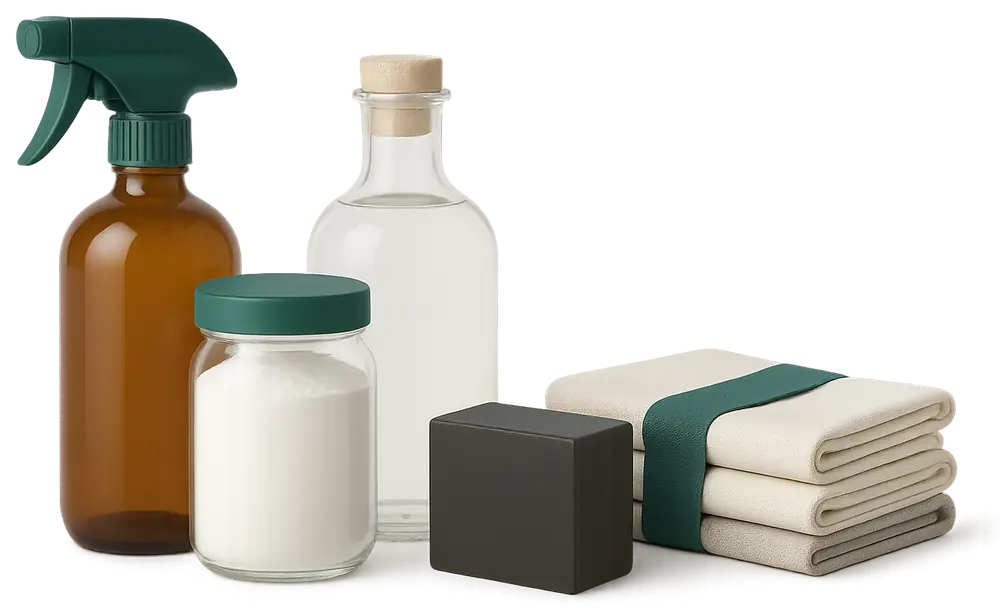
No need to buy fifteen “green” products: the essentials are a short, cheap, multi-purpose list. For the rest of your kit, see our selection in 15 essential cleaning products for short-term rentals.
White vinegar: the universal limescale remover
At around €0.50 per litre, white vinegar (8-14°) descales taps, shower screens and kettles, makes windows shine when diluted 50%, and deodorises drains. It’s the number one product for bathroom limescale, a common cleanliness complaint in reviews. Caution: never use on marble, natural stone or fragile grout, and never mix with bleach.
Bicarbonate of soda: degreaser and deodoriser
As a paste with a little water, it scrubs hobs, ovens and sinks without scratching. Sprinkled on a mattress 30 minutes before hoovering, it neutralises odours instead of masking them (see also Eliminating Bad Odours in a Rental: The Guide).
Black soap: the multi-surface floor cleaner
Diluted in hot water (2 tablespoons for 5 litres), it cleans and nourishes tiles, lino and wood floors. A 1-litre bottle lasts several months, even at 3-4 cleans per week.
Marseille soap: dishes and stain removal
Genuine Marseille soap (72% vegetable oil) replaces washing-up liquid and pre-treats laundry, including make-up stains on towels.
Citric acid: the heavy-duty descaler
For tough cases (encrusted limescale, toilet bowl), powdered citric acid is more powerful than vinegar but still biodegradable. Use gloves.
Percarbonate: laundry whitener
It revives white laundry at 40-60°C without chlorine: essential for keeping sheets and towels brilliantly white: the hotel standard, without bleach.
What natural products don’t replace: certified disinfection. Vinegar and bicarbonate clean very well but are not certified disinfectants. For touch points (handles, switches, remotes, taps), use an eco-labelled virucidal/bactericidal disinfectant (standards EN 14476 / EN 1276). Clean first, disinfect after: this is also the logic of Airbnb’s enhanced cleaning protocol (Airbnb Help Centre).
Labels: how to spot a truly eco-friendly product
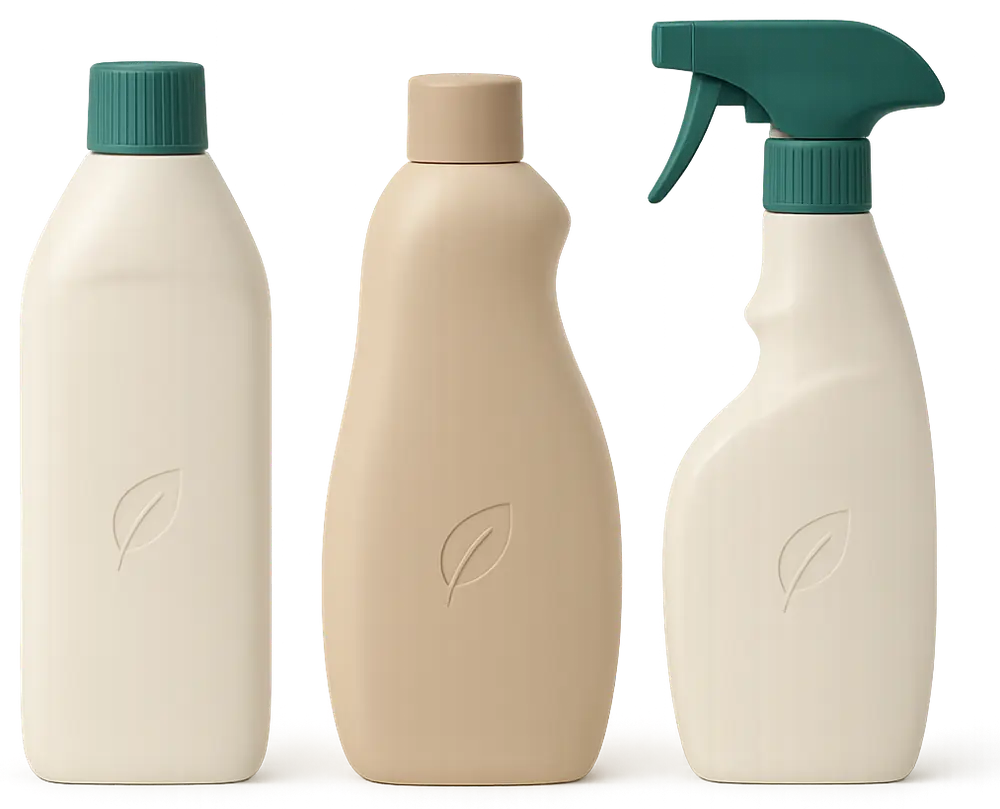
“Greenwashing” is everywhere in the cleaning aisle: green packaging means nothing. Trust labels certified by an independent body:
- EU Ecolabel: the official EU label, strict on biodegradability, aquatic toxicity and packaging, the simplest benchmark for detergents and cleaners.
- Ecocert (Ecodetergent): at least 95% ingredients of natural origin, annual checks.
- Nature & Progrès: an even stricter association standard, common among small producers.
The ADEME publishes practical guides on ecolabels and eco-friendly home cleaning: the go-to reference, and worth mentioning in your welcome booklet. Simple rule: a certified label logo on the back of the product, otherwise treat the claim as marketing.
The eco-friendly cleaning protocol, room by room
Eco-friendly cleaning follows the same order as classic cleaning, cleanest to dirtiest, top to bottom. If you’re starting from scratch, begin with our Complete Airbnb Cleaning Checklist: Never Miss a Spot then adapt the products:
- Air out for 10-15 minutesAs soon as you arrive: the first “eco” action, which refreshes the air and removes odours with no product at all, indoor air quality is a documented health issue by Santé publique France.
- BedroomsRemove linen, bicarbonate on the mattress if needed, dust with a damp microfibre, hoover.
- BathroomSpray vinegar on screens and taps, leave for 10 minutes while you clean another area, then rinse and wipe with microfibre. Citric acid for stubborn deposits.
- KitchenMarseille soap for dishes, bicarbonate paste on hobs and oven, vinegar on sink, splashback and fridge (diluted).
- FloorsBlack soap last, working backwards towards the door.
- Targeted disinfectionOf touch points with an eco-labelled virucidal product.
The secret weapon: quality microfibre. It lifts grease and most dirt with just water, where a standard sponge just spreads it around. Use a strict colour code (blue = surfaces, red = bathrooms, green = kitchen) to prevent cross-contamination, and wash at 60°C, the reference temperature for laundry in tourist accommodation, which kills mites and bacteria (Direct Hôtellerie).
How much does it cost (and how much does it save)
Let’s do the maths for a one-bedroom flat with around a hundred cleans a year. Annual eco kit: 20 litres of white vinegar (€10), 5kg bicarbonate (€15), 2 litres black soap (€12), Marseille soap (€10), citric acid and percarbonate (€20), 2 eco-labelled products (€25), so less than €100 per year, plus €40-60 for microfibres. Compared to conventional ranges, savings are often 40 to 60% of the product budget.
For laundry, eco-friendliness meets profitability: a wash cycle uses about 50 litres of water and 1kWh of electricity (Rester Connecté). Fill machines, favour 40-60°C and air dry to cut costs each time, over 100+ stays, the difference adds up to tens of pounds per property. And surfaces spared from harsh products (grout, chrome, stainless steel) last longer.
Making it a marketing asset (without greenwashing)
Eco-friendly cleaning only works commercially if it’s visible and credible:
- In your listing: a factual sentence (“Property cleaned exclusively with eco-labelled and natural products”) is worth more than ten green leaf emojis.
- In the property: a visible, labelled kit (vinegar, bicarbonate, black soap) available for guests to use for small cleans during their stay. A thoughtful touch and tangible proof.
- In the welcome booklet: two lines explaining your approach (products, recycling, water savings), with a link to ADEME. Guests who care about this will mention it in their reviews, and a review mentioning “natural products” sets your listing apart.
- In reviews: reply to comments praising your approach by confirming it. Free SEO for a positioning few others have.
A word of honesty: only claim what you actually do. A guest who finds bleach under the sink in a “100% eco” property will feel misled, and will say so.
Getting your cleaning team to follow the protocol
The classic stumbling block: the cleaner, used to their own products, brings out the bleach by the second clean. To make it stick:
- Supply the products yourself, stored in the property in a dedicated, closed box. No personal products allowed.
- Document the protocol: which product on which surface, dwell times, forbidden uses (vinegar on stone, dangerous mixes). A laminated sheet, or better, a digital checklist on their phone.
- Train in real conditions: one supervised clean is usually enough to reassure about the effectiveness of natural products.
- Check with photos: end-of-clean photos of sensitive areas (shower screens, taps, oven) let you check remotely that the result is up to standard, because the details that cost you reviews are the same, gentle products or not.
Go green, without compromising on quality
Eco-friendly cleaning is neither a compromise nor a gimmick: it’s a healthier, cheaper, more distinctive protocol, as long as it’s applied rigorously at every turnover. With cleanclac.com, turn your eco protocol into property-specific checklists with photo proof: every cleaner knows which product to use where, and you validate the result remotely after each clean.
Your questions
Does white vinegar really disinfect?
It has a partial antibacterial effect due to its acidity, but it is not a certified disinfectant (no EN 14476 virucidal standard). Use it to clean and descale, then apply a compliant eco-labelled disinfectant to touch points: handles, switches, taps, remote. Clean first, disinfect after.
Does eco-friendly cleaning take longer?
No, if you use the same method. Dwell times (10 minutes for vinegar on limescale) overlap with cleaning another area, just like with a standard descaler. A one-bedroom flat still takes about 60 minutes to clean. Only the first few cleans take longer, while the team gets used to the new products.
Which natural products should never be mixed?
Never mix vinegar (or citric acid) with bleach: the combination releases toxic chlorine gas. Vinegar and bicarbonate together are harmless but pointless (they neutralise each other): use them one after the other, not together. If in doubt, check ANSES recommendations on cleaning products.
Are eco-friendly products effective against limescale?
Yes, it’s actually their strong point. Limescale is a mineral deposit that dissolves in acid: white vinegar for regular cleaning, citric acid for stubborn build-up. With enough dwell time (10 to 30 minutes), the result matches conventional descalers, without harsh fumes.
Can I mention eco-friendly cleaning in my Airbnb listing?
Yes, in the property description or welcome booklet. Be factual: name the products or labels you use rather than slogans. There’s no official “eco-clean” badge on the platforms, but the keywords in your description and reviews boost your visibility to guests who care.
Does eco-friendly cleaning cost more?
Usually not, it costs less. The basics (vinegar, bicarbonate, black soap) come to under €100 per year per property, compared to several hundred euros for a full conventional range. Only ready-to-use eco-labelled products are sometimes pricier per unit, but you need far fewer of them.

Written by Janik
Published on August 7, 2026 · Updated on August 12, 2026
Read next
 Complete Airbnb Cleaning Checklist: Never Miss a SpotRoom-by-room Airbnb cleaning checklist: optimal order, commonly missed spots, final checks. The method for a spotless property at every turnover.Cleaning tips
 Clean an Airbnb in 1 Hour Flat: The MethodMinute-by-minute method to clean an Airbnb in 1 hour: room order, equipment, timing per area and pro tips to keep to the clock.Cleaning tips
 15 essential cleaning products for short-term rentalsComplete cleaning kit for your Airbnb: the 15 must-have products, their specific uses, annual budget, and where to store them in your property.
Move from theory to practice.
One property free to put all of this in place, for as long as it takes.