Photo Proof of Cleaning: Which Tool Holds Up in a Dispute
All apps promise end-of-cleaning photos. Few provide server-side timestamps. What makes solid proof versus just a photo, and how to check.
A guest writes three days after leaving: "the property was dirty when I arrived," and asks for a partial refund. You have photos. So does the guest. Yours show a spotless flat, theirs a mark on the worktop. The platform decides, and what matters is not the quality of the photos, but what you can prove about their date and location. Every cleaning tool promises "end-of-cleaning photos". Very few provide real proof. Here’s the difference, and how to check before you choose.
What an ordinary photo does and does not prove
A photo sent from a phone’s gallery carries EXIF metadata: a date, sometimes a location. Three problems, and they’re deal-breakers.
The date comes from the phone. It can be changed in the settings in ten seconds. A photo taken last week can show today’s date with no trace.
Metadata disappears in transit. Most messaging services and apps strip EXIF data for privacy. The photo arrives bare.
Nothing stops substitution. If the tool accepts a photo from the gallery, it accepts any photo: from a previous clean, another property, or even the listing.
None of these three points require bad faith. A rushed cleaner who forgot to take a photo might reuse one from last time, thinking it’s fine. Real proof is precisely what prevents this.
The four levels of proof, from weakest to strongest
Level 1, free photo. The cleaner sends whatever they want, from the gallery. Worthless in a dispute.
Level 2, photo taken in the app. The camera opens within the tool, the gallery is inaccessible. This is much better: the photo must be taken on the spot. But the time still comes from the phone.
Level 3, server-side timestamp. The server, not the phone, records the time when the photo is received. The cleaner can no longer backdate: they’d have to change our machines’ clocks.
Level 4, timestamp plus fingerprint and location. Along with the server time, you get the file’s digital fingerprint, a signature that changes if even a single pixel is altered, and the location at the moment of check-in. You can’t backdate, swap the file later, or claim the photo is from another property.
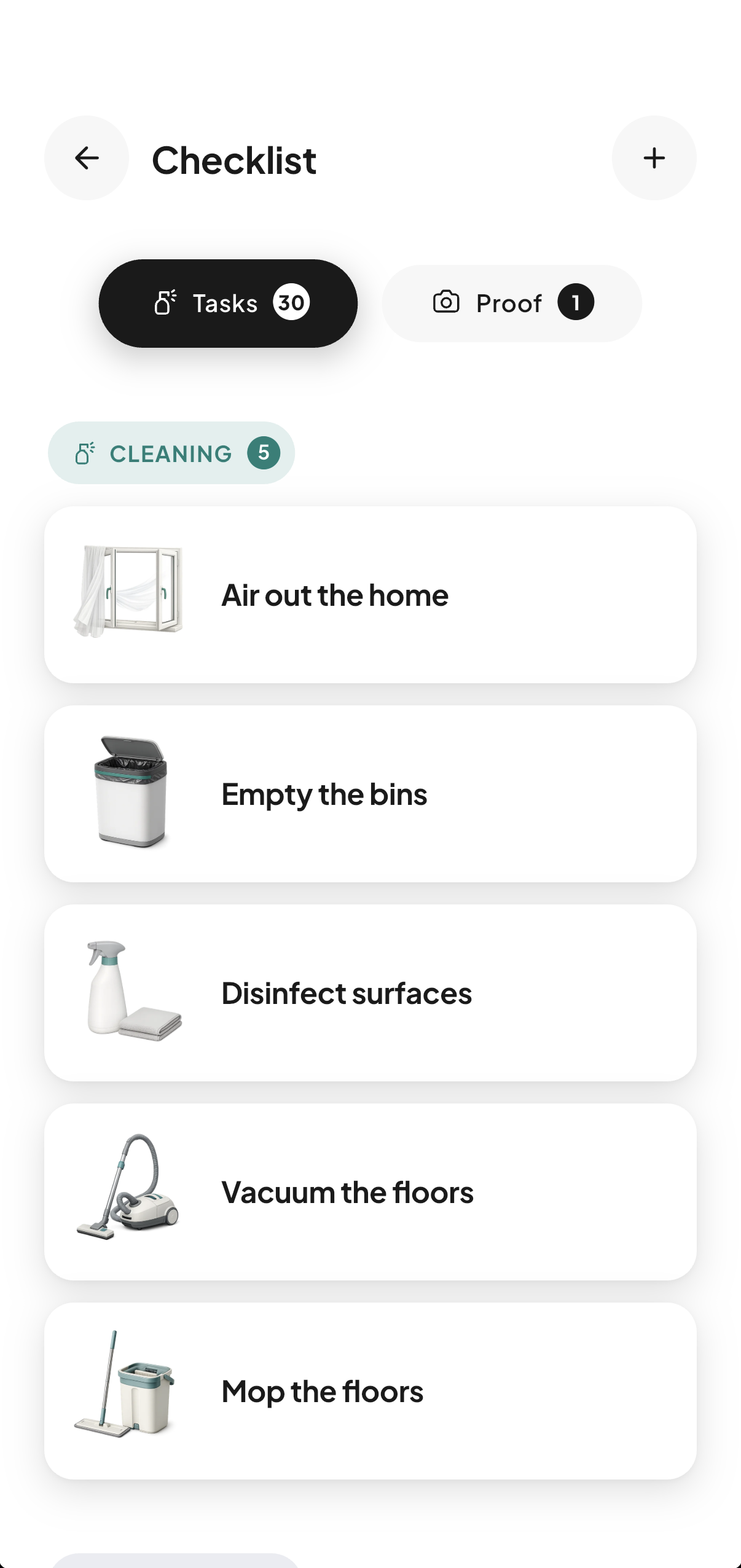
CleanClac operates at level 4, for both photos and videos. Check-in on site is geolocated, the actual cleaning duration is recorded, and the cleaner notes the property’s condition on arrival, documenting both entry and exit.
A word of honesty about what this is worth: these are robust, consistent technical elements, not a record certified by a third party. They make falsification impossible in practice, which is more than enough for discussions with a platform or guest.
How to check before you choose
Five questions to ask the provider, or to test during a trial. They take ten minutes and save you from a nasty surprise when it matters.
- "Can the cleaner send a photo from their gallery?" If yes, you’re at level 1, whatever the product page promises.
- "Who sets the time, the phone or the server?" The right answer is the server. Test it: change your phone’s date, take a photo, see which date appears for the manager.
- "Is there a file fingerprint?" This prevents swapping the photo later in the database.
- "Is the location recorded at check-in?" Without it, nothing links the photo to the property.
- "Can I export all this?" Proof you can’t extract from the tool is only reassuring for you. You need to be able to send it on.
What this changes in practice
With a guest. The discussion often ends before it starts. A screenshot showing server time and location, sent in the chat, removes the argument.
With a platform. Airbnb and Booking decide based on evidence. A dated, geolocated, consistent file carries more weight than a series of photos with no context.
With your own team. This is the least expected and most useful daily effect: when everyone knows the time comes from the server, last week’s photo disappears on its own. Proof improves cleaning even before it’s needed.
With your insurer. In case of damage, knowing the property’s condition after the last clean pinpoints when the issue appeared.
To compare the main tools on this and six other criteria, read Airbnb Cleaning Software: Which Tool to Choose in 2026.
Your questions
Do timestamped photos have legal value?
They don’t carry the weight of a bailiff’s report or a timestamp certified by a trusted third party. They are technical elements: server time, file fingerprint, location. Their strength is in their consistency and the practical impossibility of falsification, which is enough for the vast majority of disputes, which are settled with a guest or platform, not in court.
Is a photo’s EXIF data enough?
No. It comes from the phone, whose time can be changed in ten seconds, and it’s stripped by most apps when sending. It’s an indication, not proof.
Should you take photos or videos?
Both have their uses. Photos target specific points, can be compared from one clean to the next, and are easy to send. Video shows the whole space and continuity, making it hard to dispute, but it’s heavier and less readable. The most effective is a walkthrough video plus a few targeted photos of sensitive spots.
How many photos should you ask for at the end of a clean?
Between five and eight for a one-bedroom flat: one per room plus the usual trouble spots: worktop, shower, toilet, emptied bins, made bed. More than that and the cleaner rushes through, quality drops. Better a few systematic photos than lots of careless ones.
What if my cleaner doesn’t have a recent smartphone?
Server-side timestamping doesn’t require anything from the phone: our system records the time on receipt. An older device with a decent connection is enough. Location, however, does require location permissions to be enabled in the app.
Read next
 Airbnb Cleaning Software: Which Tool to Choose in 2026How to choose cleaning software for short-term rentals in 2026: the three types of tools, the seven criteria that matter, and which wins for your portfolio.Comparisons
 CleanClac or Turno in 2026: the honest comparisonCleanClac versus Turno in 2026: business model, real pricing, cleaning proof, marketplace. The strengths of each, and which suits your portfolio.Comparisons
 Turno Alternative in 2026: Avoiding Commission FeesIs Turno really free? The full breakdown of fees in 2026, plus commission-free alternatives for European hosts who already have their own team.
Move from theory to practice.
One property free to put all of this in place, for as long as it takes.