Airbnb iCal Link: Sync with Booking and Vrbo, Fixes
Airbnb iCal link: where to find it, how to sync it with Booking and Vrbo, real sync delays, fixes when it stops updating, and automatic cleans.
21 min read
You list your property on Airbnb and Booking, and on a Friday night, disaster strikes: two guests have booked the same night. Or more subtly: the booking goes through, but nobody has notified your cleaner, and the guest arrives to an unmade bed. Both mishaps have the same root cause: calendars that do not communicate. iCal synchronisation, free and built into all major platforms, solves most of the problem, provided you understand how it works, where its limits are, and how to connect your cleaning schedule.
Airbnb iCal in brief
- The Airbnb iCal link is a private calendar address, ending in
.ics, that each listing exports so other calendars can read its booked and blocked dates. - You find it in the listing's calendar and availability settings, in the section for connecting another calendar; the same place lets you import calendars from Booking, Vrbo or any other iCal source.
- Airbnb refreshes the calendars it imports at its own pace, not instantly, and the feed carries only dates, never prices or guest details.
- Importing in both directions, Airbnb into Booking and Booking into Airbnb, is what prevents double bookings across platforms.
- The same Airbnb link can feed your personal calendar or your cleaning schedule, so that every departure creates a clean automatically.
Everything below details each point: what the feed contains, the real delays, step-by-step setup, troubleshooting and the cleaning schedule.
The iCal format: how your calendars communicate
iCal (or iCalendar, files ending in .ics) is a standard calendar format, the same one used when you receive a meeting invitation. Platforms have adopted it as a common language: Airbnb, Booking, Vrbo, and Abritel all know how to export their calendar as an iCal link, and import those from others.
The principle is based on two actions:
- Export: each platform generates a unique, secret URL for your listing. Anyone with this link can read your calendar's reserved or blocked dates.
- Import: you paste this link into another platform's calendar, which then checks the URL at regular intervals and blocks on its side any dates already taken elsewhere.
By cross-importing (Airbnb imports Booking, Booking imports Airbnb), every confirmed booking on one platform blocks the dates on the other. This is the minimum setup to sell a property on two channels without double bookings.
Important point: the iCal feed carries very little information. Just dates, a brief title, sometimes a booking code. No prices, no guest numbers, no messages. This is its strength (simple, universal, free) and its limitation.
What an .ics file actually contains
Opening an iCal link in a plain text editor clears up most misunderstandings. A booking exported by Airbnb fits into five lines:
| Feed line | What it actually means |
|---|---|
BEGIN:VEVENT | start of a booking, one per stay |
DTSTART;VALUE=DATE:20260814 | arrival on 14 August |
DTEND;VALUE=DATE:20260817 | departure on the morning of the 17th, the date is exclusive |
SUMMARY:Reserved | the title, almost always generic |
UID:...@airbnb.com | the stable booking identifier |
Three very practical consequences come from these five lines.
DTEND is exclusive. A stay from the 14th to the 17th frees the property on the morning of the 17th, and it is this 17th that matters to you, as it is the cleaning day. A tool that counts DTEND as an occupied night would schedule the cleaning a day late, and the next guest would arrive to an unmade bed.
SUMMARY is most often Reserved, Not available, or Blocked, without distinguishing a real booking from a date you blocked manually for your own use. This is the origin of the phantom clean, scheduled on a day when no one is coming.
UID does not change when a booking is moved. This allows a tool to understand that a stay has been rescheduled rather than deleted and recreated, and so to move the existing clean instead of creating a duplicate. A tool that ignores the UID will create a duplicate every time dates are changed.
Why this topic is now essential
Multi-platform distribution is no longer just for experts. Nights booked in the EU via major platforms reached 951.6 million in 2025, up 11.4% in a year (Eurostat), and growth continued at +10% year-on-year in the first quarter of 2026 (Eurostat). Travellers are spread across several channels, and a host present only on Airbnb leaves part of the demand to competitors.
But every extra channel multiplies the risk of error. Blocking dates by hand is just about manageable with one property in a quiet season. With two platforms, last-minute bookings, and cleans to schedule between each departure, manual synchronisation always ends up failing. iCal is the first step in automation: it costs £0 and prevents the most expensive mishaps.
The limits you need to know before relying on iCal
iCal is reliable, but neither instant nor exhaustive. Three limits shape the rest of this guide.
The synchronisation delay
This is THE major limitation. iCal import works by periodic polling: the importing platform checks the URL at its own frequency, which you cannot adjust. Depending on the platform and timing, this refresh takes from a few minutes to several hours, and Airbnb states in its help centre that imported calendars are not updated instantly (Airbnb Help Centre).
Consequence: during this window, a night sold on Booking may still appear available on Airbnb. If a guest books instantly in the meantime, you get a double booking, with forced cancellation, possible penalties, and an impact on your ranking. The risk is low with low turnover, but real for a popular city studio in high season.
Refresh rates differ depending on the direction of synchronisation, and none can be set from your account:
| Who imports | Observed refresh rate |
|---|---|
| Airbnb importing an external calendar | from a few minutes to several hours |
| Booking importing an external calendar | about an hour |
| Vrbo and Abritel importing an external calendar | about an hour |
| Google Calendar importing a public address | slowest of all, expect several hours |
| A cleaning tool importing your links | depends on the tool, from a few minutes to an hour (CleanClac refreshes every 30 minutes, with a button to force a refresh) |
No platform commits to a figure, and none lets you choose. Treat these as observed ranges, never as a contractual guarantee: this is precisely why the minimum booking notice, described below, remains your only real protection.
A data-poor feed
iCal transmits neither the amount, nor cleaning fees, nor guest details, nor conversations. So you cannot manage your prices or messages with a simple iCal link: you need an API connection via a channel manager or PMS, a topic detailed in Channel manager, PMS, cleaning tool: the difference.
One-way per link
An exported iCal link is read-only. Importing the Airbnb calendar into Booking is not enough: you must also do the reverse, or the protection only works one way.
The Booking case: bookings and closed dates under the same label
Airbnb and Booking export their calendars differently, and this matters as soon as you connect a cleaning tool.
- Airbnb distinguishes a booking (
Reserved) from a date you have closed (Not available). A well-designed tool will not create a clean for a blocked period. - Booking.com exports all its bookings under the generic label
CLOSED - Not available, never with the guest's name, and dates you close manually come out under the same label. Its feed therefore does not distinguish between a real stay and a weekend you closed to repaint the room.
Practical consequence: each Booking reservation does create its clean on guest departure, but a manually closed date on Booking also appears as a stay followed by a clean. The best practice is to remove this clean from its record as soon as it appears, rather than have a cleaner travel for nothing. One useful exception: very long closures (over 90 nights, such as Booking's default closure at the end of its bookable period) are never treated as a stay by CleanClac, since Booking does not accept bookings that long.
If you often close dates for personal use, do so on Airbnb or in a dedicated calendar imported everywhere: the distinction will be preserved.
Setting up synchronisation step by step
Allow 10 to 15 minutes per property for a full cross-setup. Menu wording changes, but the logic remains the same.
Step 1: get the Airbnb export link
Open your Airbnb listing, then its calendar and availability settings. In the connect to another calendar section, Airbnb displays an iCal link unique to the listing. Copy it: this is a secret URL, anyone with it can read your availability.
Step 2: import this link into Booking
In the Booking.com extranet, open the property's calendar and the calendar synchronisation function. Paste the Airbnb link, name the connection, and confirm. The extranet's operation is documented on the Booking.com Partner Hub.
Step 3: do the reverse
Still in the Booking extranet, export the property's iCal link, then import it into the Airbnb calendar. The loop is closed: each platform reads the other.
Step 4: test before trusting
Block two nights on Airbnb, check that they become unavailable on Booking after the refresh delay, then test the other way. This test prevents you discovering a broken link at the moment of a real double booking.
Step 5: add other calendars
The same mechanism accepts Vrbo/Abritel, a Google Calendar for your personal blocks, or the app managing your cleans. Platforms accept several imports at once: each channel then reads all the others.
The Google Calendar case: useful but tricky
Many hosts want to see their bookings in their personal calendar, alongside everyday appointments. This is doable in a minute, and is the setup that most often disappoints, for lack of knowing two rules.
In Google Calendar, the command to use is From URL in the add calendar menu, and definitely not file import. File import takes a snapshot of the calendar: it will never update, and you will consult for months a schedule frozen on the day of import.
The second rule is about delay. Google is by far the slowest iCal reader, and its refresh rate cannot be adjusted. Never use Google Calendar as the source of truth to trigger a clean: by the time the booking appears there, your cleaner should have been notified long ago. Keep it for what it does well: a comfortable overview of your activity.
To see your cleans, not just your bookings, in your personal calendar, go via the cleaning tool rather than the platforms: in CleanClac, "Export my calendar" sends your cleans to Google Calendar, Apple Calendar, or Outlook, and your cleaners can do the same with their own schedule. The calendar then updates itself, including upcoming cleans.
One last, genuinely useful setup in the other direction: a dedicated Google Calendar for your personal blocks, exported and then imported into Airbnb and Booking, lets you block a family weekend in one go instead of entering it on each platform. Just remember to use the secret iCal address of this calendar, not its public address, and not to write anything confidential in it.
Adding the Airbnb iCal to Apple Calendar or Outlook
The principle is the same as with Google Calendar: subscribe to the address, never import the file, or the calendar freezes on the day of import.
- In Apple Calendar on a Mac, choose the option to add a new calendar subscription, paste the Airbnb iCal link, then pick an automatic refresh frequency.
- In Outlook, choose the option to add a calendar from the internet (subscribe from web) and paste the same link.
- On a phone, the simplest route is to subscribe from the computer: the subscribed calendar then follows you on the phone through your account.
These calendars are for viewing only. Changing an event in them changes nothing on Airbnb, and they refresh slowly, so they should never be what triggers a clean.
Can you give the Airbnb iCal link to your cleaner?
Many hosts start this way: the cleaner subscribes to the Airbnb link and sees departures in their own calendar. It works for a while, with three blind spots:
- The cleaner sees dates, not times, and no checklist: same-day changeovers and special requests still go through messages.
- A cancellation simply makes the event disappear: nobody is told, and the cleaner may still turn up.
- The link exposes your whole booking calendar, and stays valid after the cleaner stops working with you, until you regenerate it everywhere.
A cleaning tool reverses the logic: it reads your calendars, creates the cleans, and sends each cleaner only their own jobs, with the property's checklist. In CleanClac, cleaners can then export their own schedule to Google Calendar, Apple Calendar or Outlook, without ever holding your Airbnb link.
Classic mistakes that break synchronisation
Almost all iCal failures come from the same, avoidable causes.
- Half-closed loop: import done one way, never the other. Check both directions.
- Regenerated link: if you reset the export URL, the old link silently dies and the importing platform shows a frozen calendar. After any regeneration, paste the new link everywhere.
- Duplicated or moved listing: new listing, new iCal link.
- Confusing "blocked" and "booked": some feeds export manually blocked nights as unavailable without distinction, which can trigger false cleans in a third-party tool. Good tools know how to filter.
- Relying on instant updates: instant booking on two platforms with just iCal exposes you to the delay risk. For a high-demand property, limit instant booking to one channel.
- Forgetting check-in times: iCal carries dates, not your check-in and check-out times. Your cleaning schedule tool must know departure times to schedule cleans, especially for same-day changeovers, a scenario detailed in Same-day turnover: mastering same-day Airbnb cleaning.
Troubleshooting: when synchronisation stops updating
An iCal sync rarely fails noisily. It freezes, without warning, and you notice at the worst moment. Here are the most common symptoms, their real cause, and the fix.
| What you notice | The almost always cause | The fix |
|---|---|---|
| The imported calendar has been frozen for days | the export link was regenerated, or the listing duplicated | copy the current export link into all importers |
| Dates are off by a day | DTEND is read as an occupied night, or the two accounts are in different time zones | check the account's time zone, then retest with a two-night block |
| Cleans are created on empty dates | your manual blocks come through the feed as bookings | filter Blocked and Not available titles in the cleaning tool |
| A cancelled booking keeps its clean | the tool does not check for disappeared events | choose a tool that cancels the clean when the event disappears |
| A rescheduled stay creates a second clean | the booking's UID is ignored | same fix, this is a tool issue, not a platform one |
| Only one platform updates | the loop was only closed one way | redo the import the other way and retest |
| Nothing comes through from a specific listing | the listing was recreated, its old link is dead | get the link from the new listing |
Two diagnostic habits are worth all the tutorials. Open the export link in a browser: if it offers to download a readable .ics file, the source is healthy and the problem is with the importer. If it returns an error or a blank page, the link is dead and needs to be regenerated everywhere.
On the cleaning tool side, demand an alert when a calendar stops responding. In CleanClac, a red dot and a notification flag the property whose iCal link is no longer responding: you find out the same day, not when the cleaner misses a job.
And block two test nights far in the future, next February for example. They do not interfere with any bookings, give you a reproducible test, and tell you within an hour if the loop still works. Repeat this test after every change of listing, tool, or platform.
One last symptom is nothing to do with iCal, but still results from it: the clean is created, but nobody sees it. If your cleaner discovers jobs by calling you, it is not synchronisation that is missing, but notification: what the cleaner receives is detailed below, in the step-by-step.
Connecting your cleaning schedule to your calendars
Avoiding double bookings is only half the job. The other half is what happens between two bookings: the clean. The stakes are real: in a Vrbo survey from April 2026 of 1,758 travellers, 78% cited spotless cleanliness as the top sign of a quality listing.
This is where iCal reveals its second, often overlooked use: the same export link that protects your calendars can feed your cleaning management tool. No more acting as the messenger between your platforms and your cleaner.
Step by step in CleanClac
Connecting takes a few minutes per property, and is included from the first property, free with no time limit or card required:
- Create the propertyWith its address and default cleaning slot ("from", "until"). For a departure at 11am and arrival at 4pm, a slot from 11am to 4pm works.
- Paste the iCal linkFrom each listing (Airbnb, Booking, Vrbo, Abritel, or a Google Calendar) into the property. Several calendars can feed the same property.
- Click "Synchronise now"For the first read: existing bookings come in, and you get a notification for your upcoming cleans.
- Assign who does the cleaningOn the cleaner's profile linked to the property, activate "Assign automatically". Each new clean is then sent to them as a request, with no action needed from you.
- Let it runCalendars are checked every 30 minutes. On departure day, the clean is there, with the property's checklist.




 I don't have a calendar
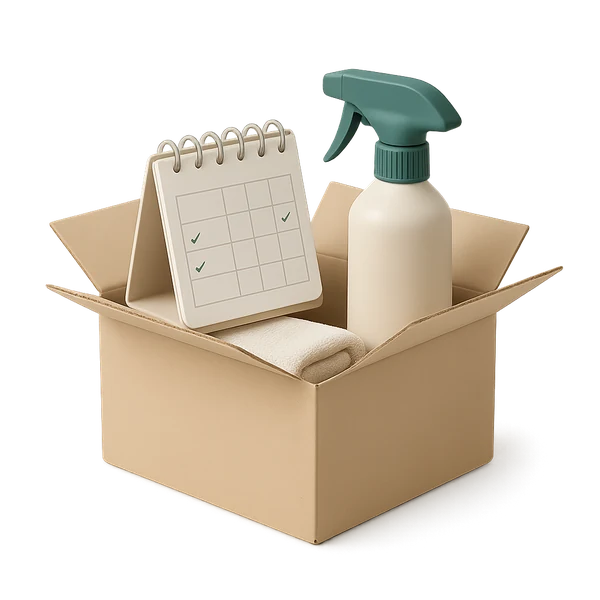

Every booking creates its cleaning
Import your platforms in one click. Every stay becomes a cleaning in your schedule, and every new booking adds another, with nothing to type.
More detailsWhat happens when the booking changes
This is where you see the difference between a tool that truly reads iCal and a simple import:
- Cancellation: the booking disappears from the feed, the clean is removed, and the cleaner is notified.
- Rescheduled dates: the clean follows the new departure day and takes the property's default slot, with no duplicate.
- Clean moved manually (a Sunday departure you prefer to clean on Monday): synchronisation does not move it back to the departure date unless the booking changes. However, you cannot move it before the guests leave.
- Clean started or completed: it is never touched by synchronisation.
- Dates blocked on Airbnb: no clean. For Booking, see the closed dates trap described above.

The cleaning follows the booking
New dates move the cleaning, a cancelled booking cancels it, and the cleaner is told.
More detailsA full step-by-step exists for each platform: Automate Your Airbnb Cleaning with CleanClac for Airbnb, Automate Your Booking Cleanings with CleanClac: iCal Guide for Booking. What the cleaner receives, requests, reminders, and backup SMS, is detailed in the cleaning notifications guide.
Three concrete benefits:
- No cleans forgotten: a last-minute Booking reservation generates its clean like any other, even if you are away.
- Cancellations are followed: when the booking disappears from the feed, the corresponding clean disappears too.
- A single source of truth: the cleaner sees their schedule in the app, with the property checklist, instead of piecing together changeovers from three WhatsApp chats.
One limitation to keep in mind: iCal only carries dates. CleanClac then relies on the property's capacity for linen and supplies, as it does not know the real number of guests. A PMS connection, however, provides this number. The whole process is summarised on the automatic cleaning schedule page.
iCal, channel manager or PMS: how far to upgrade
It all depends on your volume and risk exposure.
iCal alone is enough for 1 to 3 properties, with moderate booking pressure and instant booking limited to one channel. Cost: £0, setup in 15 minutes, very reliable as long as you follow the rules above.
A channel manager or PMS becomes relevant when the sync delay really costs you: high-demand properties, instant booking open everywhere, dynamic pricing, automated messages. The API connection synchronises bookings almost in real time and carries the data iCal ignores.
In both cases, the cleaning layer remains a separate issue: a PMS manages bookings, rarely checklists or proof of attendance. CleanClac connects via iCal directly to the platforms, from the free property, or via its PMS connectors, also free: Beds24, Smoobu, Lodgify, Hostaway, Guesty, SuperHote, Uplisting, Hostfully, and GuestWisely. Only one PMS at a time; a property from the PMS does not take an extra iCal link, to avoid duplicates. The connection is read-only: rates, listings, messages, and payments stay in your PMS. Details are on the PMS and calendar integrations page, and each connector has its guide, for example CleanClac + Beds24: the missing cleaning layer or CleanClac + Guesty: cleaning under control.
Good habits for lasting synchronisation
Four habits keep your setup reliable:
- Audit your links twice a year: check that imports point to active listings, remove dead links.
- Treat iCal URLs like passwords: never in a WhatsApp group; regenerate them if a contractor leaves, then paste them everywhere.
- Keep a buffer before arrivals: a minimum booking notice (for example, 1 day on the secondary channel) absorbs the risk window caused by the sync delay.
- Retest after every change: new listing, PMS change, or new channel, repeat the two-night block test.
Well set up, cross iCal plus automated cleaning scheduling covers the two most expensive mishaps: double bookings and unprepared properties. The next step is to choose the tool that will read these feeds, a selection made in Airbnb Cleaning Software: How to Choose the Right App, and to set up the changeover method described in Organise your cleaning between bookings without stress.
Your questions
Is iCal synchronisation between Airbnb and Booking free?
Yes, completely. Exporting and importing iCal links are native, free features of Airbnb, Booking, and Vrbo, with no subscription or extra commission. Only the tools that use these feeds (channel manager, PMS, cleaning management app) may charge, each with its own pricing.
What is the real iCal synchronisation delay?
It varies by importing platform, from a few minutes to several hours, and you cannot set it yourself. This is iCal's main limitation: during the refresh window, a night sold on one channel may still appear available on the other, hence the value of a minimum booking notice.
Does iCal synchronisation prevent all double bookings?
No, it eliminates the vast majority, but not all. The residual risk is due to the refresh delay: two almost simultaneous instant bookings can overlap. For a high-demand property, limit instant booking to one channel, require a minimum arrival notice, or switch to an API connection via a channel manager.
Can I sync my cleaning schedule with my Airbnb and Booking calendars?
Yes, this is actually one of the most profitable uses of iCal. An app like CleanClac reads your Airbnb, Booking, and Vrbo iCal links and creates a clean after every guest departure, at the property's default slot. Your cleaner sees their schedule fill up automatically, including for last-minute bookings.
How long does Airbnb take to update an imported calendar?
Airbnb checks imported calendars at its own pace, with no guaranteed delay or setting available to hosts. In practice, updates range from a few minutes to several hours depending on the time of day. You can trigger a refresh by reopening the listing's sync page, but nothing guarantees it will be immediate.
How do I get the iCal link for an Airbnb listing?
Open the listing, then its calendar and availability settings. In the connect to another calendar section, Airbnb displays a .ics address unique to that listing. It is one per listing: a host managing three properties has three different links, and mixing them up is the most common import error.
Can I sync several properties with a single iCal link?
No. An iCal link corresponds to a listing, never to a portfolio. For a portfolio, each property has its own export and import links, which quickly adds up to dozens of addresses to keep updated. This is when centralised management becomes worthwhile, a topic detailed in How to Manage Cleaning for Multiple Properties: The Method.
Does iCal transmit check-in and check-out times?
No, and this is a crucial limitation for cleaning. The feed carries dates, not times: nothing says whether the guest leaves at 10am or noon. Your cleaning tool must therefore carry the property's default departure time, or same-day changeovers become unmanageable. In CleanClac, this is the default cleaning slot for each property.
Do I need a channel manager if iCal already works?
Not unless the delay is costing you. With fewer than three properties and instant booking limited to one channel, iCal does the job for £0. A channel manager is justified when you open instant booking everywhere, use dynamic pricing, or when even one double booking a year costs more than its annual fee.
What if my imported calendar stops updating altogether?
Open the export link in a browser. If it downloads a readable .ics file, the source is fine and the problem is with the importing platform: delete and recreate the connection. If it returns an error, the link was regenerated or the listing recreated, and you need to distribute the new address everywhere. The troubleshooting table above covers other symptoms.
Why does a clean appear on a date I closed on Booking?
Because Booking exports its bookings and manually closed dates under the same label, CLOSED - Not available, with no guest name. No tool can distinguish them in the iCal feed. Just remove this clean from its record in CleanClac ("Delete clean", or "Cancel clean" if already accepted). On Airbnb, a closed date remains a blocked period and does not create a clean.
How often does CleanClac check my calendars?
Every 30 minutes, for both iCal links and connected PMS. The "Synchronise now" button on the property page refreshes everything immediately, handy just after a last-minute booking. If a calendar stops responding, a red dot and a notification alert you, so you can paste the correct link before the next departure.
What happens if I regenerate my iCal link?
The old link stops working immediately, but platforms importing it do not warn you: they keep showing the last version read, which freezes. After every regeneration, paste the new link into all relevant calendars and tools, then repeat a block test both ways.
Is the Airbnb iCal link private?
It is not protected by a password, but it is secret: only people who have the address can read it, and it shows dates, not guest details. Share it only with the platforms and tools that need it, and if it has circulated too widely, regenerate it and paste the new link into every calendar that imports it.
Can I import several calendars into one Airbnb listing?
Yes. Airbnb accepts several imported calendars on the same listing, for example Booking, Vrbo and a personal calendar for your own blocks. Each one blocks its dates on Airbnb after the refresh delay, so give each import a clear name to know where a blocked date comes from.
Can I give my Airbnb iCal link to my cleaner?
You can, but the cleaner then sees dates without times or checklists, is not told about cancellations, and keeps access to your whole calendar until you regenerate the link. A cleaning tool connected to the same link sends each cleaner only their own cleans, and is notified of every change.

Written by Jonathan Lalinec
Jonathan Lalinec is the founder of CleanClac. He compares and automates tools for short-term rentals.
Published on August 7, 2026 · Updated on November 11, 2026
Read next
 Vacation Rental Automation: What to Hand Over in 2026Vacation rental automation in 2026: messages, pricing, check-in, cleaning and reviews, what to automate, time saved and the best order to start.Tools and automation
 Airbnb Cleaning Software: How to Choose the Right AppHow to choose Airbnb cleaning software: booking sync, checklists, photo proof, team pricing, tool types compared, a 10-scenario test grid and ROI method.Tools and automation
 Channel manager, PMS, cleaning tool: the differenceChannel manager, PMS or cleaning tool: who does what, which overlaps to avoid, and the right combination for 1, 5 or 40 properties, without paying twice.
One property free to put all of this in place, for as long as it takes.